Here’s How Humor Can Improve Your Leadership Skills

Knock, knock. Who’s there? 

Drew Tarvin, the world’s first “Humor Engineer” and the instructor of Find Your Funny, an Optimism Library class designed to help professionals unlock the benefits of humor in the workplace. Tarvin, who has worked with organizations like Procter & Gamble, Microsoft, and even the FBI, believes that humor is just as important to a leader’s toolkit as strategy, vision, and problem solving. 

“Humor is more than just a way to break the ice,” he says. “It can help leaders connect with their teams, reduce stress, and boost morale. It’s an underutilized superpower, and we have some advice from an expert on how to unlock it.”

In his class, Tarvin shares his experiences working with a group of FBI agents. “They wanted to learn if humor could make them more effective in their jobs,” he explains. “Humor helps build rapport, reduce status differentials, and ultimately makes work a bit more human.” 

If the FBI can find applications for humor, it’s safe to say you can too.

Wait—Joking Around at Work Works?

Believe it or not, research backs up the benefits of humor in leadership. A study found that 91% of executives believe humor is crucial for career advancement, and employees who work under leaders who use humor are more engaged and productive. Humor creates a more positive atmosphere, fosters creativity, and can even prevent burnout. 

As Tarvin points out, “Humor reduces stress and helps people find joy at work.”

But it doesn’t stop there. Humor can make you more approachable. “People who use humor seem more relaxed and easy to connect with,” says Tarvin. It’s not about being the funniest person in the room; it’s about being relatable and creating a work environment where people feel comfortable sharing ideas. Teams that laugh together are more likely to collaborate effectively, and it’s even been found that humor at work can reduce stress and boost job satisfaction by 33%.

3 Actionable Tips for Using Humor in Leadership

Drew doesn’t just talk about the importance of humor—he offers practical advice on how leaders can use it effectively. Here are three tips from Find Your Funny to help you get started:

1. Aim for Smiles, Not Laughs
You don’t need to be a stand-up comedian to introduce humor at work. Start by adding humor in low-stakes situations—like lightening up the start of a meeting with a witty remark or sharing a funny observation. As Tarvin puts it, “You don’t need to aim for laughs every time. Aim for smiles.” 

Whether it be starting off your meeting with a cheesy dad joke or even just referencing your favorite pop culture meme, find some way to bring your own favorite brand of levity to your workday. Odds are, someone else will acknowledge it and maybe even appreciate it. Just make sure it’s not taking over everything you say–If you’re aiming for big laughs, it’s safe to say that you’re trying too hard. 

2. Use Self-Deprecating Humor
Leaders can build trust and relatability by poking fun at themselves. Bad at tech? Admit it. Did something slightly embarrassing happen to you over the weekend? Tell it to your team as a story to break the ice. Humility and good humor go hand in hand.

“Self-deprecating humor shows vulnerability and humility,” says Tarvin. It reminds your team that you’re human too. Just make sure it’s light-hearted and not too critical of yourself—it’s about balance.

3. Know Your Audience
Humor is subjective, so what’s funny to one person might not land with another. “Read the room,” advises Tarvin. Before using humor, consider the culture, context, and people around you. Be mindful to keep it inclusive and avoid any humor that could be misinterpreted or offensive.

And if you’re not sure what the team will find funny? Start a slack channel or group chat at work for sending memes and funny videos. You’ll not only get a better gauge of what your team enjoys in regards to comedy, you’ll also create a space for further bonding and community culture building. 

So next time you’re facing a tense meeting or a challenging project, ask yourself: how can humor be part of the solution? It could be the secret to unlocking not just a better work culture, but a more enjoyable path to success.

For more, check out The Optimism Library.

 

Don’t Trust Companies Who Put Customers First

“Our customers are our number one priority,” is the oft heard mantra of so many companies these days. “We put our clients first,” is uttered by so many CEOs one loses track.

But there’s a problem with putting customers first. It means that employees come at least second.

Customers should never be the priority. People should be the priority. Some of those people buy from us, some of those people work for us, and it’s only a behavioral difference. They are all people and all business decisions should be made considering the impact on the people who are on the receiving end of our decisions.

All customers and employees should both be treated equally and treated well. Not because of what they do or how they are seen but because they are both people. Customers and employees both bleed red. Customers and employees both feel happy and hurt. Customers and employees both live to feel valued for the effort they exert and the expense they put forth.

3 Easy Ways to Give Better Feedback, According to a CEO

We’ve all left a meeting feeling frustrated because the feedback you just received wasn’t helpful. It wasn’t clear, came too late, or lacked any actionable advice. Unfortunately, a recent study has even shown that 65% of surveyed employees actually want more frequent and consistent feedback but don’t feel as though they receive it. 

Many leaders of teams, especially those who are new in their leadership roles, find themselves in situations where they’re tasked with giving feedback but don’t know the best approach. This can lead to awkward, ineffective conversations that leave everyone feeling misunderstood.

Well, fear not, new leaders because we asked an expert and Optimist for her help. Enter Kristen Hadeed, founder of Student Maid, Optimist Instructor, author, and expert in all things feedback. Kristen has worked with leaders worldwide to transform how we give and receive feedback. 

Here are her three easy tips to improve your feedback and make it more effective.

1. T-Minus 24 Hours

Timing is everything when it comes to feedback. According to Kristen, the best feedback is delivered promptly, ideally within 24 hours of the observed behavior. “I try to live by something called the 24-hour guideline,” she says. “Within 24 hours of thinking or observing something, I commit to giving that person feedback.”

By addressing feedback quickly, you build trust with your team because they know where they stand with you. As Kristen notes, “You might not always agree with someone’s feedback, but I bet you trust them when you know they will address things in a timely manner.”

2. Call in The FBI

Many of us are conditioned to keep feedback strictly professional, but we get feedback wrong when we believe that keeping it professional means not making it personal and vulnerable. “Use FBI statements,” Kristen says, “list the Feeling, then the Behavior that made you feel that way, and finally the Impact it had.”

This personal approach encourages empathy and makes the feedback more impactful. Rather than just critiquing behavior, you’re showing how it influences you, which fosters a deeper connection and a greater willingness to change. It is through the expression of emotions that we are the most likely to see change. 

3. Say “Thank You”—Even When It’s Tough

Receiving feedback, especially when you don’t agree with it, can be difficult. But responding with defensiveness can shut down future opportunities for constructive dialogue. Kristen suggests a simple yet powerful strategy: “Say thank you – not for the feedback itself, but for the courage it took for the person to come to you.”

By thanking someone for bringing their feedback to you, you’re reinforcing a culture of openness. You’re also showing that you value honest communication, even when it’s uncomfortable.

When you implement these three strategies, you can transform your feedback from something people dread into a valuable tool for growth. Remember, great feedback is timely, personal, and received with gratitude.

For more, check out The Optimism Library.

How I’m Learning to Embrace Loneliness

My whole life I have managed loneliness. It’s not the kind of severe loneliness or social isolation equated with depression. Mine is a kind of loneliness that goes with being physically alone, either living alone or being single. And for most of my life, I have been one or both of those things. My loneliness feels more like a gentle sadness of longing or being without. 

For years, when the feeling of loneliness would show up, I would yearn for the thing that made that feeling go away. If I was single, I yearned for a partner. If I was home alone, I yearned for the company of another. 

I recently had a conversation with my friend Ric, who is like a guru to those who know him. I asked him if he ever feels lonely. 

“I am never alone,” he replied, “I am always with myself.”

Ric’s perspective on loneliness set me on a new path. Instead of yearning for the thing that will make my loneliness go away, I am, instead, learning to understand what it is and how it fits in—even belongs in my life. 

Here’s what I’ve learned. 

My loneliness is not a bad thing that I have to get rid of. It is now a healthy part of a balanced life for me. One of the things that comes with being alone is total freedom. I’m not just talking about the freedom to go places, though that exists too. I am talking about a more mundane kind of freedom. I can watch anything I want on TV, for example. I can eat anything for dinner, even gross combinations of food on one plate. It’s a freedom to make any decision I want, any time I want. But this incredible freedom has a price, and that price is the feeling of occasional loneliness. And because I so appreciate my freedom, this seems a small price to pay. 

The opposite is also true. I love being in relationships and with friends. I love the feeling of companionship and togetherness. But when I have that, it also has a cost. And that cost is loss of freedom. When we are with others, we have to consider their needs and wants. Sometimes at the sacrifice of our own. That’s the price of companionship.

The best relationships, the best friendships, and indeed the best personal lives are able to find the right balance between freedom and companionship. It’s sometimes an imperfect dance, but it is not about eliminating feelings of sadness or yearning; it is about weighing costs and benefits. 

Being alone or being with someone is no longer a comparison I make. One is no longer more desirable than the other. They are simply different states of being that come with their own costs. And sometimes the cost for the thing we get is worth it. 

One Mistake Too Many Leaders Make in Meetings

We’ve all been there—we’re in a meeting and the person leading the call asks a question. The conversation pauses, and suddenly, time seems to drag on at half the speed. The silence is deafening… and awkward. It’s a common scene in work environments, but it’s how leaders decide to react that defines how they will shape team morale and the psychological safety of its members.

When a meeting falls into silence—or feels stuck and unproductive—it’s a natural reaction for leaders to feel frustrated and want to call on participants randomly to engage. Elisabeth Cardiello, a seasoned communications expert and Optimist Instructor, would advise leaders to avoid this. 

Now, let’s first clarify what “calling on” means. We know every leader managing a meeting has to speak to people, ask questions, ask for updates, and generally expect a base level of participation. Those sorts of interactions would not constitute as being “called on,” given that those interactions are expected and often prepped for. Being “called on” is when a leader asks a question in a meeting, is then met with silence, and then decides to put someone on the spot and volunteer them to answer, even though they were not wanting to do so.

“Calling on people? People’s hands aren’t raised in an office,” says Elisabeth. “If you start calling on people, you’re bringing them right back to grade school, when someone was like, ‘What’s the answer to the math problem?‘ When you’re called on randomly, the natural reaction is, ‘Oh, my God, I have no clue and this is terrible.’” 

This approach can make team members feel put on the spot, increasing anxiety, and diminishing their sense of safety and comfort within the group. In the quest for engaging your team you are actively diminishing trust.

Here’s What Leaders Should Do Instead

So, how do you beat awkward silences in meetings? Well, here’s the thing… you don’t.

Instead of reverting to classroom tactics, Elisabeth recommends embracing these silences as productive and thoughtful pauses. Silence doesn’t necessarily indicate disengagement; often, it means participants are processing information, formulating thoughts, or considering their responses. Make it known to your team that you’re OK with silence and are willing to give as much time as needed for them to reflect— hopefully then the tension will dissipate and good ideas will start to come forward.

For virtual meetings, she suggests the “popcorn style” method to avoid these awkward moments. The “popcorn” method encourages voluntary participation.

“Whoever wants to share first, they unmute, they share. When they’re done, they re-mute,” she says. “The next person that wants to go unmutes and they share when they’re done, they re-mute, and so on.” If your meetings are in-person, you can still adhere to this style, simply speaking up when you want to contribute and then leaving the floor open for others to share their thoughts, as well. 

This style respects the natural flow of conversation and doesn’t pressure anyone to speak before they are ready. It fosters a more relaxed environment where people can contribute thoughtfully and at their own pace. “Silence just means that we’re being thoughtful, right? Silence is a good thing. It means we’re actually thinking there’s something happening,” says Elisabeth. 

So next time you’re leading a meeting and encounter a stretch of silence, remember it’s an opportunity for reflection, not a gap that needs filling. Encourage a culture where everyone feels they can contribute when they’re ready, not because they’re compelled to. A simple acknowledgment, such as saying “Thank you for sharing,” can go a long way in building trust and encouraging open, stress-free communication within your team.

For more, check out The Optimism Library.

Why We Need Each Other

I try, try, try and fail. Only then will I learn and improve the way to do things.

I go, go, go and trip. I stand up, brush off my knees, look back at what I tripped over so I know what to look out for in the future. Now I don’t have to trip over those things again.

I run faster and faster and faster, then miss my turn and have to go back and try again. But now I know what signs to look for to keep me moving in the right direction.

I go alone, alone, alone until I find someone on the same path and we decide to run together. I share all my falls, trips and missed turns so they can benefit from my effort. They tell me about all their falls, trips and missed opportunities so I can learn from their experiences.

Then together, we can run faster, straighter and more confidently to the place we want to go.

5 Freelance Strategies to Boost Your Earnings and Impact

Imagine this: you’ve just landed a meeting with a potential client, and now comes the big moment—discussing your rates. You want to ask for what you’re worth, but a nagging voice inside makes you hesitate. What if they think you’re too expensive? What if they go with someone cheaper? This scenario is all too familiar for freelancers, but according to Alison Grade, author of The Freelance Bible and a seasoned expert in the freelancing world, it doesn’t have to be.

Alison has spent her career helping freelancers turn their skills into successful businesses, emphasizes the importance of viewing yourself and your freelancing work as a high-value offering. In her class “Be a Great Freelancer“, Alison explains, “freelancing isn’t just about trading time for money; it’s about the impact your work has on your client’s business”. Understanding this concept is the key to not only commanding higher fees but also attracting better clients and creating more sustainable business relationships.

So, why is it beneficial to see yourself as high value? Alison points out that clients hire freelancers for two main reasons: they either need specialist skills they can’t afford to keep in-house or they need extra capacity to handle an influx of work. In either case, you’re offering something they can’t easily replicate, and that’s worth a premium.

Here are a few actionable steps to help you, noble freelancer, articulate your unique value:

1. Conduct a Skills Audit

 Take stock of your hard skills (technical abilities), soft skills (like communication and leadership), and even those “other” skills you might not think to include, such as hobbies or languages. Alison explains, “The more you understand about what you bring to the table, the better you can articulate it to potential clients.”


2. Understand the Client’s Needs

According to Alison, you should always ask yourself these two questions whenever a new project is a possibility: “Why is this client hiring me? Is it for specialist skills or added capacity?” Understanding the reason behind a client’s need for your services can help you tailor your pitch. If you’re clear on whether you’re filling a skill gap or providing much-needed support, you can position yourself as the perfect solution to their problem.


3. Articulate the Impact, Not Just the Task 

Instead of focusing solely on the tasks you’ll perform, highlight the impact your work will have on the client’s business. “It’s not about what you do, but what your work enables,” says Alison. For instance, instead of saying you’ll manage their social media accounts, explain how your work will increase their brand visibility and drive customer engagement.


4. Use Clear, Confident Language 

When discussing your rates or pitching your services, use clear and confident language. Don’t use phrases like “I think” or “maybe,” as these can undermine your perceived value. Instead, be direct about what you offer and how it benefits the client.


5. Seek Feedback and Adjust

After completing a project, don’t hesitate to ask for feedback. Grade suggests, “Understanding how clients perceive your value can help you refine your pitch and improve future client interactions.” Positive feedback can reinforce your confidence, while constructive criticism can provide insights into areas where you can further articulate your value.


By following these steps, freelancers can shift their mindset from merely completing tasks to delivering high-impact results. This approach not only helps justify higher rates but also builds stronger, more trusting relationships with clients. After all, the most important tool a freelancer can have is confidence if the hard work they have accumulated over their career. 

You are a luxury, desirable item—price yourself accordingly.

For more, check out The Optimism Library.



Hands-On or Hands-Off: Which Leadership Style Is Better?

I’ve always sworn by my laissez-faire leadership style. I tend to leave people alone and let them do their thing. I’ve debated my style with others who are more prone to micro-managing. They make the argument that they have to be hands-on because when they are hands off things go wrong too often. 

Who’s right?

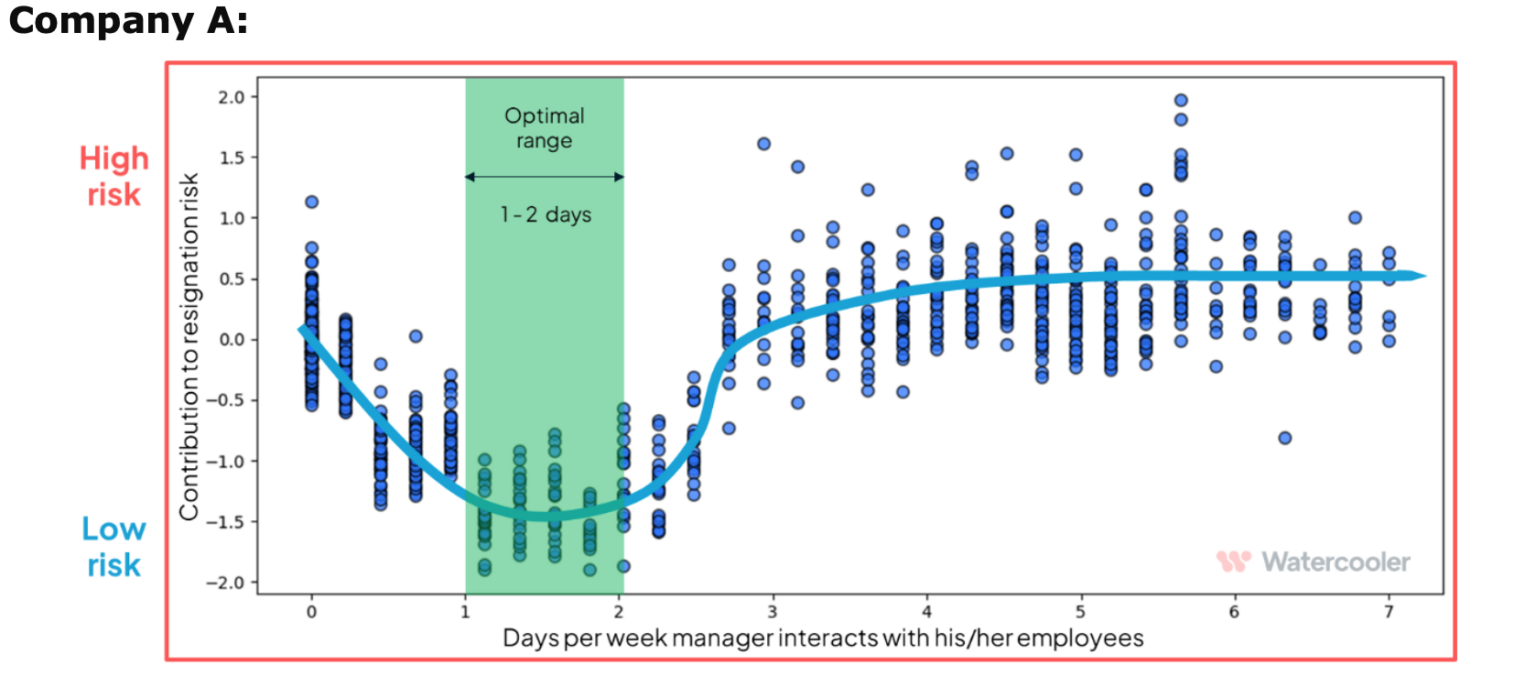
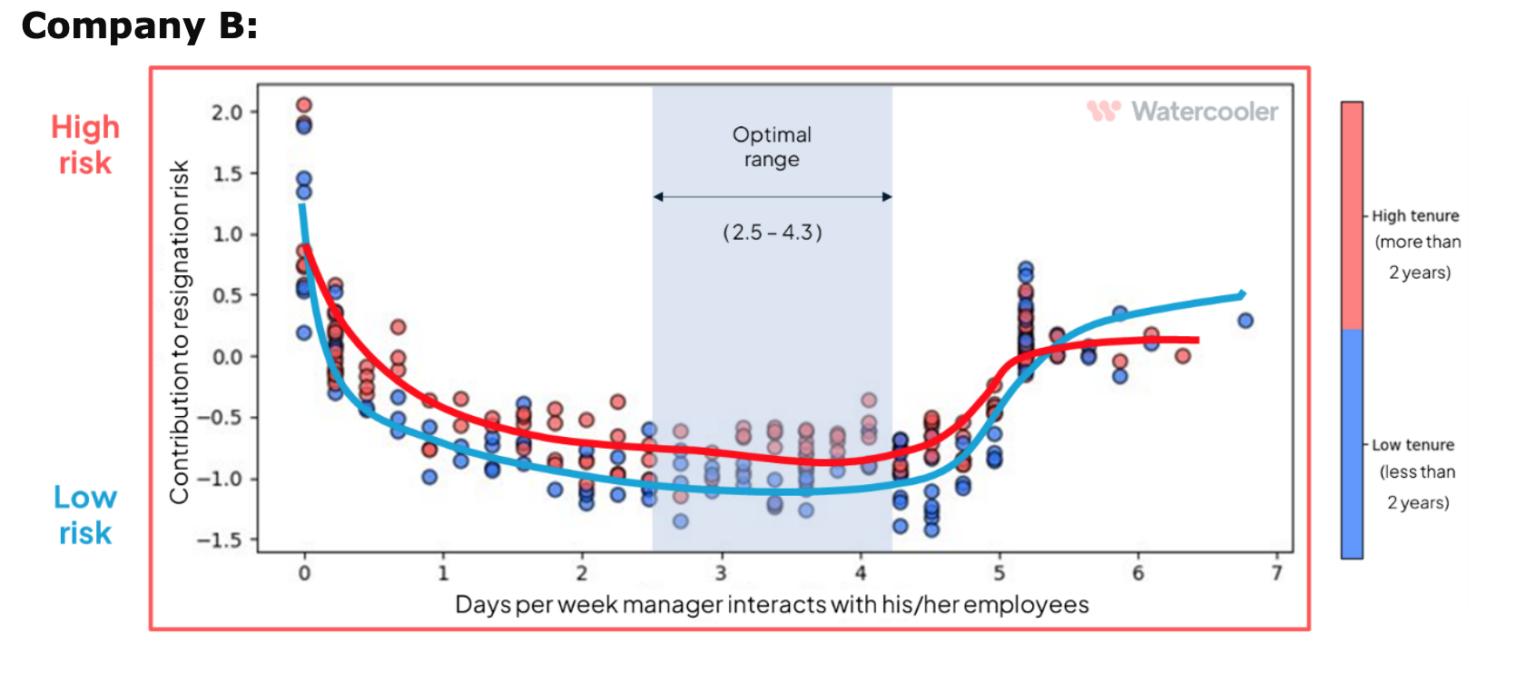
I used to give people a hard time if they worked on nights and weekends. I wanted to help them maintain work-life balance. But data that was given to me by Watercooler.ai, an AI company that looks for anomalies in the patterns of our workflow, showed me that I was actually doing more harm than good (which you can read here, if you are so inclined).

To better understand how much is the right amount to engage with our people, Watercooler showed me the data again. Unsurprisingly the right amount does vary by industry. But there is a sweet spot for each company. It turns out that engaging too little or too much can both contribute to increased chance of flight risk. 

Here are two examples:

For Company A, a sales-oriented organization, the optimal number of interactions is about 1 to 2 days during the week (including weekends). In Company B, an online training company, the frequency is interactions on 2.5 to 4.3 days during the week.

What’s important is that we need to strike a healthy balance between a hands-off and hands-on approach. Veering too far in either direction, the data shows, results in an increase of flight risk.

This kind of insight is particularly valuable when we move from one company, culture, or industry to another. What worked in our old job, may not work as well in our new job. AI can’t replace human leadership but can help show good leaders what they need to adjust to be the best leaders they can be for the culture in which they work. 

I’ve become so interested in the data that Watercooler analyzes that I became an advisor and investor in their company. The best part is that I get to have regular conversations with the CEO, Eitan Vesely, and his team and they show me what they are learning. Here’s a clip from a recent webinar we did together:

If you find this interesting and would like to hear more, here’s the link to the full webinar.

How Good Businesses Balance Employee Autonomy with Top-Down Control

Nothing can feel quite as soul crushing at work as when we take initiative to try something new and we’re shot down with words: “That’s not how we do things here.”

It’s simply a fact that, in any business, there’s a persistent tension between a centralized, top-down approach and the desire for team autonomy. This balancing act is crucial: how can we maintain alignment with the company’s goals while empowering employees to adapt, innovate, and take initiative on the front lines?

Striking this balance is essential for success. We need employees to buy into the larger corporate direction, but not at the cost of stifling individual creativity.

Will Guidara, bestselling author, renowned restaurateur, and former owner of the world’s #1 restaurant, Eleven Madison Park, describes this dilemma as the battle between “restaurant smarts” and “corporate smarts.” While his lessons are rooted in the restaurant industry, they are universally applicable to any business environment.

What Does “Restaurant Smart” Mean?

“Restaurant smart” companies lead with trust, granting frontline workers autonomy and creative freedom. These companies cultivate nimble environments where employees can serve customers with ingenuity.

“Think about Zappos, the online shoe retailer,” says Will. “In their call center, the customer service agents are given the freedom to go above and beyond for their customers. On one occasion, when one of the phone representatives learned of a customer’s sick mother, they took it upon themselves to send flowers to the mother’s hospital room. Most companies would think that was a waste of time and money. Zappos looked at it as an investment.”

However, while this approach fosters innovation and customer-centric service, it can also pose challenges. Companies that rely too heavily on flexibility and creativity may struggle with profitability due to a lack of standardized processes and controls. 

As Will says, “It’s very hard to scale a company if you’re only restaurant smart.” The very flexibility that drives innovation can also hinder consistency and efficiency—both critical for growth.

What About “Corporate Smarts?”

On the other hand, “corporate smart” companies prioritize systems, controls, and profitability, ensuring that every operation is streamlined and consistent. This approach, often driven by centralized decision-making, guarantees a uniform product and experience, regardless of location.

“McDonald’s is a corporate-smart company,” says Will. “Every time you walk into a McDonald’s, the product is exactly the same. You can expect consistency and efficiency, but it’s very rare that you leave a McDonald’s feeling anything but full.” 

The strength of corporate smarts lies in scalability and profitability, but it often comes at the expense of creativity and customer satisfaction. Frontline workers may feel disempowered, with little autonomy to make decisions that could elevate the customer experience.

Striking the Right Balance

The key to success lies in merging the best aspects of both approaches. By fostering creativity within a framework of efficiency and control, businesses can enhance customer satisfaction while achieving sustainable growth and profitability. This balance also fosters a sense of passion and purpose among employees.

“The challenge is to figure out how your company can be both restaurant smart and corporate smart, how to embrace the tension between control and creativity, and find the balance between the two,” says Will.

One example is Pret a Manger, which empowers its frontline staff while maintaining corporate controls. Pret cashiers have the autonomy to give away free drinks or food to customers they feel deserve it, acknowledging that those on the front lines have the insight needed to make such decisions.

To achieve this balance in your business, consider the following steps:

  • Empower Your Frontline Workers: Give employees the autonomy to make decisions that enhance the customer experience. Start small and build from there.
  • Establish Clear Systems: While empowering your team, ensure that systems are in place to maintain efficiency and control. This could involve setting guidelines for decision-making or implementing feedback loops to monitor the impact of creative initiatives.
  • Foster a Culture of Trust: Encourage open communication and trust within your organization. Make sure that creative ideas are welcomed and that employees feel supported in their roles.

As Will reminds us, “Even the smallest change can have a very significant result.” Start small, but start today—your business’s future depends on it.

For more, check out Will and Simon’s course, The Art of Creating Fiercely Loyal Customers.

Curiosity is essential
                for progress.
SimonSignature

We fully agree, so we like to reward curiosity.
Use code GETCURIOUS for 20% off your next purchase.

A spark is something quite small and, by itself, not very powerful. But a spark has the ability to ignite. An idea is like a spark; alone it is just a set of words, but it too can ignite. A great idea can inspire others to dream bigger. Let us all work together to ignite something greater than ourselves.

Let us all be a Spark of Optimism.