The Résumé Trick That Gets You Noticed

We all want to stand out in a crowded job market, and it’s no secret that tailoring a résumé that sets us apart is crucial to boosting our chances of catching a potential employer’s eye.

While many hiring experts will tell us that we need to be scientific about certain fonts—and others will tell us that we need to highlight achievements in a specific way—we’d like to emphasize the importance of something equally, if not more, powerful: communicating our personal WHYs clearly at the top of our résumés and tying those WHY’s to the organization’s larger brand purpose.

Now, if you know anything about our Chief Optimist, Simon Sinek, you’re probably familiar with his concept of The Golden Circle. According to Simon, applying the Golden Circle to our résumés is an incredibly powerful tool.

When we apply this strategy to our résumés, we’re not just presenting our qualifications; we’re also showcasing our unique contributions and cultural fit—factors increasingly important in the hiring process. 

Here’s how to do it.

Step One: Identify Your WHY Statement:

Reflect on what drives you. What are the core values and passions that motivate you? This might relate to personal growth, a commitment to innovation, or a desire to contribute to societal change. (For more help on discovering your WHY, see here and here.)

Our WHY statements are the articulation of who we are at our natural best. It’s what we’re doing when we’re the most inspired, most passionate, and most fulfilled. 

For example, Simon’s WHY is “to inspire people to do the things that inspire them, so that together we can change the world for the better.” 

Other examples of WHY statements could be:

  • “To empower those who are next so that together we can give the world new potential.”
  • “To curate joy, so that we can all inhabit happiness.”
  • “To connect authenticity with communication, so that together we can create meaningful relationships.”

Step Two: Research the Company’s Brand Purpose:

We need to understand the mission, vision, and values of the companies we’re applying to. This information is usually found on their website, whether it be in their mission statement or recent press releases.

Now, our personal WHYs and the company’s WHY needn’t be a one-to-one match. But hopefully, we can find something about the company’s purpose that resonates with us. If not, it could be a red flag that the company isn’t the right fit. (After all, a survey by SelectOne found that 72% of workers consider corporate culture a key factor in their decision to stay with a company, and 32% of those who left a job within the first 90 days cited a mismatch in company culture as the reason for their departure.)

Step Three: Align Your WHY with the Company’s Brand Purpose:

Let’s say we’re applying for a role at Adidas. Their brand purpose statement is clear: “Through sport, we have the power to change lives. We will always strive to expand the limits of human possibilities.”

At the top of our résumé, we should explain in one sentence how our WHY is complementary to the company’s goals. As an example, if Simon were applying for a role at Adidas, he could say something like this:

Driven by a passion to inspire, I believe in harnessing the power of sport to elevate human potential and create meaningful change in the world.”

Instantly, the Adidas hiring manager will know that Simon might be a good cultural fit.

Remember: Résumés reflecting our values are more likely to catch an employer’s attention, especially when we’re applying to highly competitive roles. 

14 Ways to Have Better Mondays, According to Team Simon

Mondays—the day Garfield hates and The Mamas & The Papas sing about. We’ve all dreaded a Monday or two, haven’t we? According to Forbes Health, a whopping 80% of all working professionals and over 90% of Millennial and Gen-Z workers suffer from what’s more recently been coined as the “Sunday scaries.” 

Even we at Team Simon aren’t immune to the occasional Monday blues. But, being the Optimists we are, we’ve made it our mission to add a little positivity to your Mondays. So, in the spirit of helping others and spreading some joy, we are sharing some of our favorite Monday survival strategies that you may or may not find useful.

If you’ve found any of them helpful—or wish to share your own better-Monday strategies—we’d love to hear from you at [email protected]

1. Prep Your Morning Coffee on Sunday Night

“Did you know we literally make thousands of decisions a day? One way I reduce my Monday-morning decision-making is by prepping my coffee ahead of time. I take some time on Sunday afternoons to make a pitcher of cold brew so it’s steeped and in the fridge, ready to go. With iced coffee in hand, I can start the week feeling ahead of the game.” —Rebekah, Marketing

2. Take 15-Minutes to Walk Around the Block

“I’ve gotten in the habit of starting my week with a walk around the block, typically just before breakfast. It’s like fresh air for the soul. Too often we can overlook the enormous benefits of a simple stroll. Also, it’s excellent for your creativity and thinking through problems. If you’re feeling stuck on something, my advice is to try walking it off.”  —Sara, Empowerment

3. Try a Special Monday Self-Care Routine

“I swear by my feel-good Monday self-care routine: I wait for the sun to rise, and then go for a walk with my cat. After work in the evening, I take another long walk with my cat. When we get back, I play music and do yoga in a sunlit room. Afterward, I meditate! By this point, I am feeling really happy regardless of how the day went. It’s about being kind to yourself. On an extra special day, I’ll soak in the hot tub in the evening too.” —Lisa, Tech

4. Take 5 Minutes to Tidy Your Workspace First Thing in the Morning

“As a remote worker, I’ve found that incorporating small rituals into my Monday routine makes a big difference in my productivity and mood. I always start by taking a few minutes to ensure that my workspace is clean and organized. Yes, it’s a small thing, but science has my back on this: Studies show that a clean desk can help with productivity, creativity, and a calm and clear mind. What’s more, it can instantly make you feel more professional and ready to get down to business.” — Pai, Experiences

5. Embrace “N.M.M.M.” (“No Meetings Monday Mornings”)

“I love my job, but I also love sleeping, so sometimes Mondays can be hard, even for me. I’ve been trying to uphold the hard rule of ‘No Meeting Monday Mornings.’ So, unless something is absolutely urgent and completely on fire, the calendar is blocked off. It feels like a nice soft landing into the work week, and I can focus on setting up my week for maximum success without having to rush to grab that extra Monday morning coffee between client calls.” —Sharin, Experiences

6.Take $10 to the Grocery Store and Treat Yourself

“I live within walking distance of my grocery store, so to brighten my Mondays, I usually go for a ‘superfluous’ snacks and beverage run. Anything I otherwise wouldn’t buy, I treat myself to. I will avail myself of Kettle Chips, La Croix, Outshine popsicles, or a chocolate croissant. Yes, it’s a simple pleasure, but it can make all of the difference to your mood.” —David, Production

7. Try Some High-Intensity Exercise

“Monday mornings are when I set aside time for a 45-minute virtual fitness class that I find on YouTube, usually a mix of cardio and light resistance training. I choose high-intensity routines to essentially shock my body into a higher gear to start my week, which leaves me feeling sharper, more energetic, and alert. Afterward, I’m fully prepared to dive headlong into work.” —Henrietta, CEO

8. Create a Special Monday Soundtrack

“I make my Mondays fun with music. I start my day with my favorite Spotify playlist of Animal Crossing lo-fi to trick myself into thinking that being productive matches the vibe of the music. (Am I inadvertently classical conditioning myself? Who’s to say—but all I know is I feel better doing work if my mind thinks that I’m doing that work for my little animal villager neighbors on my five-star-rated island.) Then, in the afternoon, when go for a walk, I try to listen to a new album each time. It’s the perfect combo of familiar favorites in the morning and something new and exciting to look forward to in the afternoon.” —Emily, Marketing

9. Plan a Social Outing for Monday Night 

“Just because it’s Monday doesn’t mean you can’t have fun plans! It can be a game night with friends, a movie, a dinner reservation, or a bike ride. I think sprinkling activities throughout the weekdays, in general, is a great way to get out of the house (especially if you work fully remote) and a way to ensure you aren’t trying to cram all your fun into just the weekends!” —Olivia, Operations

10. Save Your Fave Food for Monday Night

“I love to indulge in a more weekend-appropriate dinner on Monday nights, like pizza, a burger, or pad Thai. I find that having something to look forward to early in the week is a real mood-booster. In terms of nutrition, Tuesdays feel like my Mondays.” —Keenan, Marketing

11. Attack Your Biggest Project Head-On

“After I’ve caught up with my team and held my morning meetings, I’ll always block out as much time as I can on Monday afternoons to hyper-focus on the biggest project that will make the rest of the week feel better once it’s complete.” —Greg, Content

12. Create a Light Landing Into Your Work Day

“Move easier meetings first, harder meetings to later in the morning. This allows me the space to embrace my weekend catch-up first and plan my day and week out a bit. It also creates space for me to relax on Sunday night knowing I don’t need to be prepped for anything first thing in the morning.”  —Molly, Experiences

13. Have a Quick Catchup with Your Teammates

“Having a quick status meeting each Monday always starts the week off on a really nice foot. I get to see my awesome team, be reminded of all of the brilliant things they do, and we get clarity on who’s doing what for that week. It’s a great way to connect, say hi, support each other, and give everyone autonomy to execute from that point forward.” —Joi, Operations

14. Touch Grass!

“Yes, I know it’s a meme online, but it’s especially for remote workers to get out into the world, even if it’s for a very short amount of time. You’ve got to feel some sunshine and talk to someone—even a gas station attendant!” —Zach, Production

3 Ways Your Brain Is Sabotaging You at Work, According to a Neuroscientist

We would all love to go to work each day feeling unburdened by stress and unhelpful thoughts—those that hold us back from trying new things, getting more done, and embracing difficult situations. 

But we also know that our brains can be set in their ways, what with their roughly 100 trillion synaptic connections, some of which actively undermine our productivity every minute. 

That’s why, according to Dr. Stu Farrimond, Optimist Instructor and acclaimed author of Science of Living, we often hold ourselves back at work without even realizing it. Some of our worst behaviors—like procrastinating, under-communicating, or being indecisive—stem from letting our deeply ingrained habits take control and switch our brains to autopilot.

Here are three ways Dr. Stu says your brain acts as your own personal saboteur, with the hope that knowing about them will help you in replacing your brain’s bad habits with better ones. (For more, check out Dr. Stu’s class, “The Neuroscience of Success at Work,” in The Optimism Library.)

 1. Your gut instincts are trustworthy only in familiar situations

“Our brain’s amygdala, an area deeply involved in emotional responses, helps forge ‘emotional memories’ that can guide instinctive reactions in familiar situations,” says Dr. Stu. 

This can be a good thing. For example, a seasoned manager might successfully rely on gut feelings to make quick decisions during routine operations or when resolving conflicts they’ve navigated before, leveraging past experiences encoded in their emotional memory.

In these familiar moments, Dr. Stu says it’s great to “trust your gut.” 

He cautions, however, trusting your gut in unfamiliar or unpredictable situations. Maybe you’re facing a new problem, trying to manage a new sort of conflict, or trying to work through a task you’ve never done before, like implementing an entirely new technology in the office.

“Your hunches can only be trusted in areas of life that are fairly predictable and repeatable, like driving or cooking,” he says. “However, in unfamiliar or unpredictable situations, relying on gut feelings can lead you astray. This insight is underpinned by studies showing the unreliability of eyewitness testimonies in stressful situations, which often result in wrongful convictions.”

2. Our brains are often too quick to make assumptions

Dr. Stu describes the brain as a “sophisticated guessing machine.”

Our vision, for instance, isn’t as reliable as we might think. “Our brain fills in gaps in our peripheral vision, creating a continuous image from sparse data,” he says. “This mechanism, while efficient, makes us very unreliable witnesses, a fact supported by research showing a high percentage of wrongful convictions based on inaccurate eyewitness testimonies.”

The same concept can be found in the workplace, especially in intrateam communication. Consider a scenario where a manager asks for updates on a complex process with many moving parts. They might believe they have a full understanding of the project status based on quick visual scans of progress charts and brief updates from team members, but in reality, their brain is filling in gaps and creating a seemingly coherent picture from incomplete information. This can lead to overconfidence in the project’s progress or unforeseen issues that were never actually communicated but were assumed to be resolved. 

When it comes to collaborating with your team, Dr. Stu says it’s best to over-communicate to the point of obviousness—because what is often obvious to you is not always clear to the rest of the team or your superiors.

3. You can teach an old brain new tricks.

Sure, humans can get stuck in their ways. But bad habits, we’re thrilled to say, can be broken—or, more accurately, bad habits can be replaced with good ones.  

According to Dr. Stu, the brain can be reprogrammed to foster better workplace behaviors and decision-making. 

“The concept of schemas,” he says, “are rooted in cognitive behavioral therapy (CBT). Essentially, we know schemas as a sort of bodily autopilot. They are the patterns of thought and behavior that we default to after repeated learned behavior. The good news is, schemas can be adjusted.”

Our brain’s neuroplasticity and ability to adapt can significantly alter our responses to workplace challenges, “leading to more effective and adaptive behaviors,” says Dr. Stu. “It can take time, but if we repeat and reinforce better habits at work, we can replace one habit with another.”

A workplace example here could be how we handle feedback. 

Imagine a scenario where an employee typically reacts defensively to constructive criticism, viewing it as a personal attack rather than an opportunity for growth. This reaction is a schema—a learned behavior based on past experiences. By recognizing this schema and treating it like a habit, the employee can begin to replace the defensive response with a more productive one, such as asking clarifying questions or considering the feedback as a path to professional development. 

Over time, with conscious effort and repetition, this new approach can become the default, demonstrating the brain’s remarkable capacity to adapt.

For more, check out The Optimism Library.


The Best Way to Give Effective Praise at Work, According to Simon

  • We all love praise, but delivering it effectively is a learned skill.
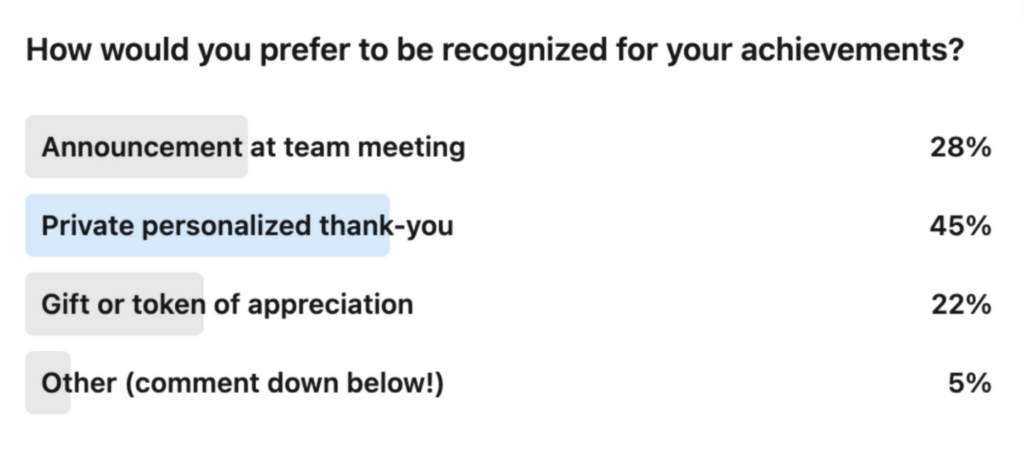
  • The Optimism Company recently conducted a poll with 13,790 participants, revealing that most workers prefer to be praised in private rather than in public.
  • Simon reveals his go-to method for giving effective praise.

Fact: We all love praise. Be it a little compliment on an outfit, a thank-you for some help with a task, or even just a thumbs-up after a presentation, praise is a ray of sunshine that can clear up a cloudy day. And yet we often forget that giving praise effectively is actually a skill. 

It’s not just about saying “good job” and moving on; it’s about making your team members feel valued and appreciated in a meaningful way. Also, how you choose to deliver your praise—whether it’s in public, in private, in person, over Slack—can make all the difference. 

For perspective, we recently conducted a poll to learn more about how people prefer to be acknowledged for their good work, and 13,790 people participated. The results were fascinating:

Turns out, most of the respondents indicated a preference for private conversations. This suggests that personalized, one-on-one praise goes a long way for many workers.

Others, however, felt differently. Some enjoy being acknowledged in front of their peers. Others value tangible rewards or gestures of appreciation, such as a handwritten note or a small gift.

Equally as interesting were the variety of detailed responses we received in the comments to our poll. People shared their unique and creative ideas for how they like to be praised. Here are just some of the comments from our poll participants (ed note: some have been lightly edited for clarity):

From Tonya B.:

I personally don’t need public accolades. However, I have learned that when it comes to work, praising in public can open doors. People are impressed by this sort of thing, so it can lead to new opportunities. So tell the world. Otherwise, an email for my ‘kudos’ folder and a cash bonus would be great!

From Sarah M.:

I love when my manager takes the time to give me specific feedback on my work. It shows that they’ve really paid attention and appreciate my efforts.

From Emily S.: 

“I appreciate when praise is tied to the bigger picture. Knowing how my contributions contribute to the team’s success motivates me to keep up the good work.”

From Cole T.:

“If promotion, raise, or bonus are not an option, then my preferred recognition would be a personal meeting with my leadership team where I was thanked for the stellar work and given the opportunity to share my key learnings from the experience. I could also  provide feedback on where I encountered hurdles and inefficiencies. This would really make me feel truly appreciated as it demonstrates to me that they actually care about the work I put in along with any ways the process can improve for next time.”

From Chuck D.:

“It’s not about how. It’s about intentions. Authenticity is powerful and memorable.”

As you see, giving praise effectively isn’t necessarily one-size-fits-all. 

Simon’s Tips for Giving Effective Praise

When choosing the setting for your praise—whether in a team meeting, a company town hall, or one-on-one—use your best judgment based on your knowledge of the employee and their preferences. When in doubt, Simon advises making it a one-on-one conversation.

“In-person is always the best,” he says. “Over-the-phone is second best. Giving praise over email and text are weak substitutes. As a general rule, if you can email someone, you can call them.”

For the praise itself, Simon suggests structuring it in a specific way:

  • Start with, “Here’s the thing you did.”
  • Then, say, “Here’s how I feel about what you did.”
  • Follow with, “Here’s the impact of what you did.”

He provides this example:

“Jennifer, when I was in your meeting the other day, I saw the way you talked to your team. It made me so proud and showed that you are the best example of our values. I am confident that if you keep doing that, your team and group will thrive beyond any of our expectations.”

Feels good, doesn’t it?

More Useful Advice from The Optimism Company

The Best Way to Give Feedback without Damaging Morale

Simon’s Red Flags for Knowing When to Quit Your Job

How to Master the Art of Working Less and Achieving More

Start Any Presentation with Confidence: Simon’s Expert Tips and Tricks

How to Master the Art of Working Less and Achieving More

  • Learn the art of practicing “strategic laziness,” a productivity mindset that teaches you to minimize your efforts while maximizing your results.
  • Research shows that productivity declines significantly after working for 55 hours per week. Your objective should be to optimize your working hours and your off-work hours.
  • Continue reading for valuable tips from Denise Green, an Optimist Instructor and an expert in achieving work-life balance.

One of the worst things about being overwhelmed at work is that it creates a vicious cycle. The more you stress about your workload, the more time you spend actively trying to manage that stress. Consequently, you end up spending more time stressing and less time actually working. 

But how do you fix it? Well, Optimist Instructor and work-life balance specialist Denise Green suggests a counterintuitive trick that can help break this cycle: learning the art of strategic laziness.

No, really. Embracing laziness will indeed make you more productive. (We weren’t kidding when we said it would seem counterintuitive.)

So We Don’t Have to Work Very Hard Anymore?

Not exactly. Strategic laziness is a productivity strategy that teaches you to minimize your efforts while maximizing your results.

Denise swears by it, and teaches the core tenets of strategic laziness in her class, Conquer Overwhelm and Boost Productivity, which you can access in our Optimism Library

“Strategic laziness may feel lazy, but it’s not,” she says. “It’s like saying animals are lazy for taking a nap. Animals understand that without rest, they won’t be able to hunt and survive. However, we often believe we can keep going endlessly, which is not the case.”

The Truth About Laziness

We all know that laziness has always been viewed as something of character flaw. But despite what “rise and grind” influencers may tell you, laziness is a genetic trait shared by all humans, hardcoded into our DNA to aid in survival. Energy is a limited resource, after all, and humans have evolved to be mindful of how they expend it.

“Athletes and musicians understand this,” says Denise “They know that without proper rest, their performance suffers. Understanding this concept will not only help you overcome burnout and excessive work but also increase your productivity and enhance your reputation.”

With that in mind, here are a few tips for putting strategic laziness into practice and accomplishing more by embracing your inner couch potato:

1. Rethink Your Definition of Success

Instead of measuring success by the number of hours worked or tasks completed, focus on the value you produce. Embrace the concept of the “minimum viable product” in your daily tasks. Ask yourself, “What is the least I can do to be productive and create value?” This doesn’t mean compromising quality; it means finding the most effective way to achieve results without burning out.

2.  Understand Your Limits

A study by Stanford University found that productivity per hour declines sharply after working more than 50 hours a week. Beyond 55 hours, productivity drops so much that putting in more hours becomes pointless. Embracing strategic laziness, which includes periods of rest, can offset this decline in productivity.

3. Leave Your Desk Several Times Per Day

If you’re finding yourself staring at a blinking cursor on your computer or doomscrolling, take a walk with your pet, meditate, grab a coffee down the street, or even take a shower. Do something to get a change of pace and reset your stress. After all, a lot of times your best ideas come to you when you’re not working.

4. Try the Pomodoro Timer Method. 

Select a single task to focus on and set a timer for 25 minutes. Use that 25 minutes to do some deep work on the task until the timer goes off. Then you take a 5 minute break to walk around, get a snack, relax, etc. Set your timer again, repeat cycling your bursts of working and breaks for three of four rounds, and then take a longer break of about 30 minutes.

According to Denise, you’ll be amazed to discover how much work you’ll get done when you formalize a short burst of time in which you allow yourself to hyper-focus on your work.

5. Get to Know Your Optimal Routine. 

Sometimes working against your nature isn’t the way to go. Take the time to check in on your brain and body throughout the day. Are you more productive in the morning or the afternoon? Do you work better after a meal? Does tea help your focus? Find what conditions work best for you and schedule your workday to be complementary to them. 

For example, you may find that your mornings are best suited to creative work and your afternoons are best suited to meetings and admin. Recognize your moments of peak performance, and arrange your day around those moments. 

6. Enjoy Lower Stress Levels

In addition to improving productivity, strategic laziness also helps preserve your mental and physical health by reducing stress and anxiety associated with overworking.

Continuous work without adequate breaks can lead to chronic stress, which can contribute to serious health problems such as heart disease, high blood pressure, and mental health disorders like depression or anxiety. Incorporating strategic laziness into your routine, such as taking short naps, engaging in light physical activities throughout the workday, or setting boundaries on work hours, can significantly mitigate these risks.

“Remember, strategic laziness isn’t just about finding time to relax—it’s about making relaxation a strategic part of your success,” says Denise. “Embrace it, and watch how it transforms not just your work life but your entire well-being. You deserve it.”

For more, check out The Optimism Library.

Where Does Vision Come From?

Only after years of abuse and demand for change did American revolutionaries embrace the idea of starting their own nation. In other words, the vision came second.

The drive to build a business from scratch is the same. The desire to solve a problem or build a better mousetrap comes first. The vision comes later.

So people feel they need to have a vision before they can do their life’s work or “find their passion” will likely die searching. 

Think of it like going to space—the goal may be clear, and the problems to solve may be in front of us, but the view of the planet from space is unknown until the spacecraft gets into orbit. It is that view that creates the vision for something more profound. As almost every astronaut reports when they return to earth—it was the view, a planet of infinite beauty and without borders—that inspired them to become more idealistic and care more about world peace. 

So, put the need to find a vision aside…for now…and find a problem to solve, a suffering to relieve, a person or people to help. And from that passionate drive to do good, the vision will emerge. It is at that point that the vision will serve as a beacon for something even bigger than the original problem we set out to solve.

3 Game-Changing Tips for More Effective Meetings

  • Statistics reveal that 47% of workers consider meetings the top “time waster” at work, while 45% of all working professionals feel overwhelmed by their meeting schedules.
  • The essentials for productive meetings include assigning three specific roles within your team, establishing clear goals, and consistently concluding meetings on times ending in “5” (e.g., 1:55pm, not 2pm).
  • Communication expert and Optimist Instructor Lori Zukin explains these tips and more.

Meetings: love them or loathe them, they’re with us to stay. If you’re lucky enough to rise through the ranks, statistics suggest that a significant chunk of your work hours—up to 50% for upper management—could be spent in meetings. That’s a staggering 30,000 to 45,000 hours over an entire career, akin to watching the entire Lord of the Rings trilogy nearly 4,000 times from start to finish. 

No wonder the refrain “this could’ve been an email” is so common.

But what if meetings didn’t have to be a drain on time and productivity? According to communication expert Lori Zukin—who teaches a popular course in The Optimism Library called “Make Meetings Efficient and Productive”—the key to great meetings lies in one word: structure. With the right framework, meetings can become more than just hum-drum gatherings—they can be opportunities for collaboration, clarity, and progress.

Here are three simple tips from Lori to get you started:

1. Assign Exactly Three Roles Among Your Team for Every Meeting

“Knowing who owns the meeting can drastically improve its effectiveness,” says Lori. “Having clarity on who is the owner, even if it’s a fast meeting, is helpful, especially if you want to keep it fast in the first place.”

Note: This ownership also means owning all follow-up actions. 

Alongside a meeting owner, Lori recommends designated a notetaker and a timekeeper, as well. 

“Assigning someone to take notes and another as a timekeeper ensures that A) important decisions and details are remembered and B) the meeting runs smoothly and respects everyone’s time,” she says. 

2. Schedule Your Meetings to Conclude on Numbers That End in “5”

Instead of scheduling a meeting to run from 1:00pm to 2:00pm, Lori recommends a simple yet effective hack: Schedule it to run from 1:00pm to 1:55pm. Instead of hosting a meeting that runs from 2pm to 2:30, make it 2pm to 2:25pm. 

This slight adjustment provides crucial buffer time between meetings, allowing participants to decompress, address urgent tasks, or simply take a breather. In a remote-work world filled with Zoom calls, this could simply mean giving your team the opportunity to use the bathroom. 

These short breaks are vital for sustaining energy and concentration throughout the day, enhancing productivity and reducing the strain of consecutive meetings. 

“Having 5 minutes in between meetings can significantly enhance productivity and reduce the stress associated with back-to-back scheduling,” says Lori.

3. Yes, Every Meeting Needs a Stated Goal Agreed Upon Beforehand

Every meeting should begin with a clear agenda that acts as a roadmap for the discussion, ensuring that all participants are aligned with the meeting’s objectives. 

“Ideally you’ve done it before,” says Lori, highlighting the importance of preparation. “A well-planned agenda includes the meeting’s title, date, time, location, and participants, along with a detailed outline of what will be discussed.” 

This transparency ensures that everyone understands the purpose of the meeting and is prepared to contribute effectively. This agenda can also be where the aforementioned notetaker can compile the takeaways from the meeting in a place everyone can see them. 

Oh, and if you don’t have a clear goal you want to achieve for your meeting? According to Lori, that’s a surefire sign that the meeting could’ve been an email. 

For more, check out The Optimism Library

3 Effective Ways to Turn Your Workplace into a Community

  • Research shows that a strong sense of community at work improves performance, reduces turnover risk, and results in fewer sick days. 
  • We can all do our part to build a sense of community with small but effective gestures: asking the right questions regularly, prioritizing praise and recognition, and creating shared lists of interests.
  • In this article, entrepreneur, speaker, and Optimist Instructor Rachel Drunkenmiller, who specializes in assisting organizations find purpose and build strong cultures, provides expert tips.

Amid our daily tasks, back-to-back meetings, urgent emails, and ever-growing to-do lists, it’s all too tempting to believe there aren’t enough hours in the day to think about bigger things like fostering a sense of community at work. (After all, isn’t that HR’s job?) 

But research suggests that prioritizing a sense of community at work is well worth our time. 

A study by Deloitte found that those who experience a strong sense of belonging enjoy a 56% increase in job performance, a 50% reduction in turnover risk, and a 75% decrease in sick days. What’s more, research published in the Academy of Management Journal found that stronger work communities are hotbeds for the type of workplace connections that result in promotions and stronger emotional support, while fulfilling a very human desire to serve and give back to others. 

While building a community is, of course, a group effort, there’s a lot we can do individually to help. According to Optimist Instructor Rachel Druckenmiller—an entrepreneur, speaker, and consultant who teaches a class in The Optimism Library called “The 3 Keys to Effective Employee Engagement”—you don’t have to go as far as asking your team to run a marathon together, join a book club, or perform trust falls. 

You can try three simple things.

1. Create a Shared List of Interests

“Here’s a fun thing I advise all teams to do: Create a list called ‘Our Favorite Things,’ and invite people to fill it out,” says Druckenmiller.

The things can range from serious to silly—personal passions, exercise routines, comic-book movies, go-to snacks, coffee orders, television shows, and restaurants.

Once completed, everyone will have the opportunity to get to know their coworkers better. What’s more, it can inspire thoughtful gestures. 

“It’s just this beautiful way to connect,” says Druckenmiller. “And it doesn’t have to just be peer-to-peer, either. It can be boss-to-direct reports, or from one department to another. Anybody in the organization can acknowledge and be inclusive towards somebody else.” 

2. Ask These Two Golden Questions

Druckenmiller singles out exactly two questions that can significantly impact how supported and valued your team members feel: 

  • “How can I best support you right now?” 
  • “Is there anything you need to do your job better?” 

While these may sound like questions best asked in a yearly review, she advises you to ask these questions regularly. They show a genuine interest in each employee’s well-being and professional needs. They also reflect a curiosity that, as Simon points out, “is core to empathy and all interpersonal interactions within the workplace.” 

3. Repeat After Us: “Praise, Praise, Praise”

“It’s a fact: There are five-and-a-half times more praise and recognition than there is critiquing on high-performing teams,” says Druckenmiller. “On low performing teams, it’s inverted. There are three times as much criticism and critiquing as there is praise.”

Yes, recognizing people matters. “It’s about making sure that we’re focusing on appreciating what is good, and calling out what is good, and not waiting till someone’s on their way out the door to tell them why we value them,” says Druckenmiller.

At the end of the day, she says, it’s a preponderance of small stuff that can turn a mundane office into a thriving community. 

For more, check out The Optimism Library

Try This One-Minute Breathing Exercise to Instantly Calm Your Mind

  • Learn how your brain is hardwired to skew towards negative thoughts, and why practicing gratitude helps.
  • Gain insights from Omar Brownson, an Optimist Instructor, successful entrepreneur, civic leader, and expert in gratitude and mindfulness. 
  • Omar reveals step-by-step instructions for his helpful, one-minute breathing exercise to calm your mind.

Are you stressed out these days? You’re hardly alone. In fact, if you believe the folks at Bloomberg, the single biggest unifying force in America right now is our collective stress level

According to LA-based entrepreneur, civic leader, and Optimist Instructor Omar Brownson (who is also one of the most trusted authorities on the subject of gratitude and mindfulness), there are plenty of effective ways you can better cope with your stress on a day-to-day basis. He details them all in “The Gratitude Class,” which you can access in The Optimism Library. But we took the liberty of laying out his go-to one-minute breathing exercise for chilling out that you can try at work—or anywhere else—below.

The Importance of Gratitude

Omar categorizes gratitude as a critical lens through which we can view our experiences in a more positive light. He explains, “If meditation helps us notice each breath, and mindfulness helps us notice change, then gratitude helps us notice good.”

Our brains naturally skew towards negativity. For whatever reason, stress and negativity tend to stack up and store in our thoughts. Gratitude acts as an essential counterbalance. Omar describes it as “an antidote to that negative orientation,” which is vital for emotional well-being and resilience.

This mindset isn’t just about ignoring the negative but rather about recalibrating our focus to appreciate the positive, thereby “rewiring our brains and even rewilding our hearts.” Practicing gratitude should not only be recognizing good but also fostering an environment where positive emotions are triggered more readily than negative ones.

Step-by-Step Breathing Exercise to Cultivate Gratitude

Here’s Omar’s simple yet profound breathing exercise to help individuals anchor themselves in the present moment and foster gratitude. Below is a guided walkthrough from Omar’s class on how to conduct this practice. And the best part? It only needs to take a minute or two:

1. Get Comfortable

“I invite you to get comfortable in a way that works for you. Whether you want to close your eyes or just gently rest them away from the screen, find a position that allows you to feel at ease.”

2. Notice Your Breath

“We’re just going to take a few moments to notice our breath. Notice the seat that is holding us. Notice our feet on the ground.”

3. Focus on the Details of Breathing

“With each breath, maybe bring some attention to where you feel it entering. Maybe you feel it in your nostrils, your throat, your chest, or your belly. And maybe focus on the exhale. Do you feel the heat of the exhale in your nose?”

4. Awareness of Tension

“Bring some attention to your body. Notice your shoulders wherever there might be some tension. No need to do anything about it. Just bring some awareness to it.”

5. Heart Awareness

“The last place we’re going to bring some awareness to is just our hearts. Notice, is it beating fast? Beating slow? Does it have a feeling attached to it?”

6. Return to the Room

“As this last breath invites you to bring your attention back into the room, I came to this space. And open your eyes when you’re ready.”

This practice is designed to slow down the mind, allowing you to shift from a state of doing to a state of being. It’s not just about relaxation but about cultivating an acute awareness of the present, which is crucial for gratitude.

Omar’s perspective on gratitude goes beyond simple thankfulness. It’s a practice that can profoundly affect our emotional and psychological health, helping us to navigate the complexities of life with a more positive, resilient outlook on the days to come.

Use this quick breathing exercise at the point in your day when you feel the most stressed. 

For more, check out The Optimism Library

Curiosity is essential
                for progress.
SimonSignature

We fully agree, so we like to reward curiosity.
Use code GETCURIOUS for 20% off your next purchase.

A spark is something quite small and, by itself, not very powerful. But a spark has the ability to ignite. An idea is like a spark; alone it is just a set of words, but it too can ignite. A great idea can inspire others to dream bigger. Let us all work together to ignite something greater than ourselves.

Let us all be a Spark of Optimism.