Genius Team-Building Games That Actually Work

Trust falls. Ropes courses. Icebreaker games. Two truths and a lie. Let’s face it: few things in corporate life are as loved and loathed (read: usually loathed) as when HR departments or team leaders thrust team-building games or team-building exercises on hard-working employees. After all, it’s one of the great paradoxes of life: whenever bonding or simply having fun is forced in an organized way, it’s all but guaranteed not to work.

But is that always the case? The short answer: Not at all. Team-building exercises, when executed thoughtfully, can genuinely enhance team dynamics and foster a more cohesive working environment. The key is to make these activities engaging and relevant, allowing natural interactions to take place. It’s all about execution, reading the room, and letting it flow in a natural way. If cringe sets in, you ditch the game and move to another one. 

Studies show that team-building exercises can significantly improve communication, trust, and collaboration within teams. According to a Gallup survey, teams with high engagement levels experience 21% greater profitability, 41% reduction in absenteeism, and 59% less turnover.

Whether you’re in the office or working remotely, the following team-building games are actually great for successfully encouraging team bonding and elevating morale. Seems like a win-win scenario, right? Then get ready to unleash your inner geniuses with these creative challenges that will leave everyone laughing, strategizing, and connecting like never before. 

The 10-Minute Build-a-Story Challenge

How to Do It: Bring your team together either in a meeting room or virtually. Explain the rules of the team-building game: One person starts a story with a single sentence, preferably something totally weird (“In a world where paperclips replaced money, a fearless team of accountants decided to take matters into their own hands…”), which is written onto a shared Google Document that is either projected onto a screen or shown on the shared virtual screen. 

Then, working across the room, everyone takes turns adding one sentence. Everyone gets exactly one minute to write their sentence. You’ll perform the game for at least 10 minutes or until the energy peters out. The key is to move quickly and to not give enough time for people to make their sentence perfect. Just let it flow and encourage silliness, messiness, and randomness.

Why It Works: Storytelling is a powerful tool for enhancing communication and creativity within teams. By building a story together, team members practice listening, improvisation, and contributing ideas without overthinking. This game reduces the friction between thought and speech, making team members more comfortable sharing ideas.

What to Do If People Hate It: Always give someone the opportunity to sit out and observe. But also be sure to give positive encouragement to every sentence. “That’s a killer segue, thank you for contributing it!” and “Always good to keep it simple!” Also, it’s great to constantly remind your team that no one is a professional writer. It’s simply a fact that the worse the story, the better the exercise.

[Related: For more on this topic, explore Simon’s Team-Building Programs here.]

The 15-Minute Logic Game

How to Do It: Complete simple challenges in 15 minutes. This involves three clues/riddles/puzzles that need to be solved sequentially.

  1. Game 1: The Word Game
    • Clue: “Find the hidden word in this jumble: E H S U O”
    • Answer: “HOUSE”
  2. Game 2: The Visual Riddle
    • Clue: Show an image with various items and ask, “What do all these items have in common?”
    • Answer: “They are all used for cooking.”
  3. Game 3: The Logic Puzzle
    • Clue: “You have a 5-liter jug and a 3-liter jug, and you need exactly 4 liters of water. How do you do it?”
    • Answer: Fill the 5-liter jug and pour into the 3-liter jug until it’s full, leaving exactly 2 liters in the 5-liter jug. Empty the 3-liter jug and transfer the 2 liters from the 5-liter jug to the 3-liter jug. Refill the 5-liter jug and pour into the 3-liter jug until it’s full. You now have exactly 4 liters left in the 5-liter jug.

Why It Works: These logic games are fantastic for fostering problem-solving skills and teamwork under pressure. They require effective communication, strategy, and collaboration.

What to Do If People Hate It: Offer the option for participants to join as observers. Encourage the team by celebrating small wins and providing hints if they get stuck to keep the momentum going.

The 7-Minute Puzzle-Solving Challenge

How to Do It: Here’s a specific puzzle-solving challenge that can be done in 7 minutes, either in person or virtually.

Puzzle: The Grid Logic Puzzle

  • Create a 4×4 grid using a spreadsheet or a PowerPoint and provide clues such as:
    • “The number 1 is not in the first row.”
    • “The number 2 is directly below the number 3.”
    • “The number 4 is in the same column as the number 1.”
  • Teams have 7 minutes to correctly place the numbers 1-4 in the grid based on the clues.

Why It Works: This type of logic puzzle enhances critical thinking and deductive reasoning skills. It also encourages teamwork as members must collaborate to solve the puzzle efficiently.

What to Do If People Hate It: Ensure that everyone understands the rules and provide easier clues if the team is struggling. Reinforce the idea that the objective is to have fun and practice problem-solving, not necessarily to complete the puzzle perfectly.

20 Questions Trivia

How to Do It: Time to put your knowledge to the test with Team-Based Trivia! Whether you are remote, in-person, or hybrid, you’ll be able to gather your team in groups and unleash a barrage of questions related to the company, industry, and general knowledge. It’s a battle of wits, and the team with the most correct answers takes home the glory.

Sample Questions:

  1. What year was our company founded?
  2. Who is the current CEO of our company?
  3. What is our company’s mission statement?
  4. What are the names of the three largest clients we serve?
  5. What is the capital of France?
  6. Which planet is known as the Red Planet?
  7. Who wrote “To Kill a Mockingbird”?
  8. What is the largest mammal in the world?
  9. How many continents are there on Earth?
  10. Who painted the Mona Lisa?
  11. What is the chemical symbol for gold?
  12. Which country won the FIFA World Cup in 2018?
  13. What is the smallest prime number?
  14. Who was the first president of the United States?
  15. What is the currency of Japan?
  16. What year did the Titanic sink?
  17. What is the tallest mountain in the world?
  18. What is the hardest natural substance on Earth?
  19. Who discovered penicillin?
  20. What is the longest river in the world?

Why It Works: Trivia games are excellent for boosting team spirit and fostering a competitive yet friendly atmosphere. They allow team members to showcase their knowledge and learn new facts in an enjoyable way.

What to Do If People Hate It: Encourage participation by emphasizing the fun aspect and not the competitive nature. Allow teams to choose topics they are interested in and provide diverse categories to appeal to everyone.

And there you have it—a collection of genius team-building games to turn your team into an unstoppable force of camaraderie and success. From escape room challenges to cup tower constructions, these fun team-building exercises will leave your team motivated, energized, and better equipped to tackle any obstacle that comes their way. So go ahead, put on your game face, and embark on these thrilling adventures in teamwork!

Remember: a strong team is a winning team. And if you’re looking for other ways to strengthen your team, check out our ever-growing collection of classes in The Optimism Library. Help every member of your team build the essential human skills they need to succeed in their professional and personal life. Each class also comes with a discussion guide to promote important conversations at your organization.

4 Clever Ways to Beat Back Negative Thoughts

All of us grapple with that little inner voice whispering doubts and fears. I don’t know what I’m doing. What if these numbers are wrong? I’m in over my head… This plan would never work. It’s as if we all have an internal saboteur on our payroll, working tirelessly to chip away at our confidence.

Dr. Judy Ho, a triple board-certified clinical psychologist—and an Optimist instructor who teaches the class, “Stop Self Sabotage and Achieve Lasting Success”—would like to help us all deal with it. Dr. Judy, renowned for her practical and scientifically grounded approaches, teaches us how to turn our inner critic into a supportive ally and offers a few powerful strategies to conquer self-sabotage.

“Thoughts do not always equal the truth,” Dr. Judy says, “Self-sabotage happens when we start prioritizing those thoughts and replacing the truth entirely.” So when we start to feel those self-sabotaging thoughts begin to form, it’s all about shifting our perspective… and there are four different ways we can do it.

1. Put Our Thoughts “On Trial”

A negative thought crosses our minds. We ask ourselves, “Is this thought factual?”

For instance, if we think, “I’m never good at presentations,” we challenge this by looking for evidence. Have there really been no instances where we’ve done well? Adjusting this thought could look like, “Sometimes I feel nervous about presentations, but I have received positive feedback before.”

2. Modify Our Thoughts to Be More Balanced

Once we’ve questioned our thoughts, it’s time to modify them. This involves reshaping them to be more balanced.

For example, take the thought, “I can’t handle this project; it’s too complex.” Instead, we try thinking, “The project is challenging, but I can handle parts of it well and can seek help for the rest.”

This approach acknowledges difficulty without dismissing our capabilities.

3. Take the Sting Out of Our Thoughts by Labeling Them

We can minimize their impact by labeling them as mere mental events.

So, for instance, the thought, “I’m going to fail,” can be transformed by thinking, “I’m having the thought that I might fail.”

This simple tweak helps us see the thought as not an inevitable truth but a fleeting feeling.

4. Inject Positivity Where We Can

If the original thought is, “I don’t have what it takes to succeed,” we begin our morning by listing our strengths and recent successes. Change this to, “I have succeeded before, and I have the specific skills and experiences to help me succeed again.”

In other words, we take our self-doubting thoughts and turn them into an opportunity to empower ourselves. We rewrite the narrative, silencing the inner saboteur and transforming it into an ally that highlights our capabilities and potential. The goal isn’t to never have negative thoughts, but to change how we interact with them.

For more, check out The Optimism Library.

The Single Best Way to Peacefully Resolve Conflicts at Work

Conflict—while it’s usually what makes stories exciting and TV shows bingeable, it’s rarely something that we ever look forward to at work. Dread it as we might, however, conflict in the office is inevitable. In fact, a recent study from SHRM state that two-thirds of U.S. workers have experienced conflict or incivility at work in the last month alone.

Navigating conflict at work is a skill that transcends industries and job roles, and while there are several methods to manage workplace disputes effectively, we want to double down on a very important element to conflict resolution that we often forget to do…listen. 

In fact, listening is the first component of the L.E.A.D.E.R. approach to conflict resolution, taught by Col. Chris Rogers in his Optimism Library class all about navigating conflict at work. “To approach conflict at work like an effective leader,” Chris says, “you have Listen, Examine, Acknowledge, Describe, Engage, and Reaffirm. That’s the L.E.A.D.E.R. model. And while each component of the L.E.A.D.E.R. model plays a vital role, it’s the act of listening that sets the stage for successful conflict resolution.”

Isn’t That Kinda Obvious?

Now, we might hear this and think that listening when people are discussing a problem with us is a given. But think about the last time you were at odds with someone. 

Many conflicts come from inciting incidents that hurt us, frustrate us, and drum up negative motions. These emotions create an “us vs. them” mentality which rarely makes us want to hear the other person out. 

We know it can be hard, but putting aside our own emotions and listening actively for the purpose of understanding the issue from all possible perspectives is fundamental. 

(Here’s a handy hack if this bit is proving a little tricky: Type up your side of the argument, put it into your favorite AI content generator, and ask it to rewrite your argument as devoid of emotion as possible. Reading the new version will hopefully allow you to take a step back from your own feelings and approach the impending discussion with a bit more neutrality.)

Put the Active in Active Listening

Listening isn’t just about hearing words, either; it’s an active, deliberate process. “You always have to start with listening,” Chris says, pointing out that while the other steps in the L.E.A.D.E.R. model are sequential, “listening is a continuous thread throughout any conflict resolution process.” It’s about understanding and empathy, not just waiting for your turn to speak. Listening demands engagement: nodding, maintaining eye contact, taking notes, and responding appropriately and thoughtfully. Doing these things helps us interpret the emotional subtext of the conversation, which can often reveal the real issues at play.

It’s a Good Habit to Have

“Active listening should be seen as a habit,” says Chris, “It’s something that has to be practiced by everyone on the team, regardless of if you are in an active conflict or not.” It’s only when an entire team commits to the habitual practice of active listening that both individual interactions and overall company culture can thrive.

The impact of listening extends far beyond the immediate conversation. It builds trust—a commodity that, once established, can significantly reduce the time needed to resolve future conflicts. Chris says, “If we don’t have an appreciation for the other side of our conflicts, those conflicts will never get truly resolved long term. We may not understand where that person is coming from when we first enter into the conflict, but we have to at least respect the perspective that they bring in order to find any sort of long term peace.” Holding a space of empathy fosters connection, respect, and, eventually, a greater sense of trust. 

So, next time you find yourself in a conflict at work, listen up and actually hear them out.

And for more about the L.E.A.D.E.R. model, check out The Optimism Library

The Right Way to Stand Up for Yourself at Work

We all know that speaking up in the workplace can be daunting, but advocating for ourselves is not just beneficial. It’s essential. 

Whether it’s handling tough conversations, resisting unreasonable demands, or ensuring our efforts are acknowledged and valued, standing up for ourselves is crucial. This is particularly true for women as, according to a recent Indeed survey, a staggering 70% of female employees recognize the need to develop self-advocacy skills—yet only 30% feel prepared to do so effectively.

For any type of sustained professional growth or personal well-being, we have to be willing to effectively advocate for ourselves… The tricky bit is just knowing how to do it. 

Enter Rachel Druckenmiller, CEO of UNMUTED, and Optimist Instructor who teaches “Speak Up: Be Your Own Self Advocate at Work”. No matter your personality type or experience level, she has an easy and impactful technique that you can use to become a more effective advocate for yourself at work. 

Rachel’s secret to becoming a more assertive self-advocate is to identify and eliminate your “energy vampires.” She says:

“Identify the parts of your day that are disproportionately exhausting relative to their value to your role or the organization.”

Here’s how:

A Step-by-Step Guide to Eliminating Our Energy Vampires

  • 1. List Your Tasks:

Start by jotting down every task you handle regularly. Include everything, no matter how minor or infrequent it may seem.

  • 2. Assess Energy Impact:

Next to each task, mark whether it’s an energy drainer or an energy booster. Be brutally honest about how each task affects you. Rachel says, “Brutal honesty is crucial in identifying the vampires—those tasks, processes, or even people who significantly sap your motivation, joy, and energy.”

  • 4. Create an Action Plan:

For each vampire task identified, determine whether you can eliminate it, schedule it less frequently, or delegate it. This step involves removing the task, finding a less frequent timetable for it, or handing it off to someone else who is better suited to take it on.

  • 5. Communicate Your Needs:

With this analysis in hand, prepare a detailed proposal for your manager that outlines how redistributing these tasks will allow you to concentrate on areas where you can deliver the most value. Emphasize how this realignment benefits not just your well-being but also the productivity and outcomes of your team. Adopting a “solution-oriented” rather than a “problem-oriented” approach is key. 

  • 3. Categorize Your Tasks:

Decide which tasks are critical and align with your job requirements and which could be shifted to others. This might include automating repetitive administrative duties or delegating them to an intern, or perhaps reducing your attendance at less critical meetings. Rachel says,

“Pinpoint the tasks that drain your energy and devise strategies to minimize or remove them from your responsibilities.”

Here’s how to frame it:

Solution-Oriented: “After analyzing the return on investment of my direct efforts, it’s clear that when I engage in TASK X, we see a measurable improvement across various metrics. If I could focus more on TASK X, I believe we could further enhance our organizational performance. I am eager to expand my involvement with TASK X, but I find that TASK Y and Z are limiting our potential. I propose we adjust our approach accordingly.”

Problem-Oriented: “ “I don’t want to do this. It is a time-suck that is beneath my skills and experience level.”

By identifying tasks that do not leverage our unique skills and proposing thoughtful, strategic changes, we can significantly improve organizational effectiveness. More often than not, our bosses will thank us for it. 

For the full class and more advice, check out The Optimism Library

The Job Skills Most Impacted by ChatGPT, According to Science

It’s always nice when scientific research supports what we already know to be true: Being a human being actually matters—even in the age of AI.

A new study just published in the academic journal Technological Forecasting and Social Change examines the job skills most impacted by the AI technology ChatGPT. The research identifies 185 skills influenced by ChatGPT, emphasizing the importance of Human Skills in the AI age. It also highlights four essential skills necessary for effectively working with ChatGPT, offering a roadmap for professionals to adapt and thrive.

Key Job Skills Most Affected by ChatGPT

The study analyzed more than 616,000 tweets about ChatGPT and cross-referenced this data with job information from ESCO, the EU’s database on skills, competences, and occupations. The findings reveal that ChatGPT most significantly impacts the following areas:

  • Script programming
  • Responding to inquiries
  • Writing storylines and songs
  • Rewriting articles
  • Editing scripts
  • Creating digital content
  • Providing information
  • Problem-solving
  • Assisting with homework

Nothing super surprising here, but these results show that ChatGPT is overwhelmingly used for tasks involving computer programming and various forms of writing. Now, contrary to concerns about AI replacing jobs in these fields, the study suggests otherwise—that these roles can simply enhance their productivity by leveraging AI for routine tasks while focusing more on the more creative, human-focused aspects.

The Essential Human Skills in the AI Era

The study notes the enduring value of Human Skills, which are critical for success in a technology-driven world. These include:

  • Communication, collaboration, and creativity
  • Working with computers
  • Assisting and caring
  • Social and communication skills
  • Self-management
  • Critical thinking

Put simply, these skills highlight the necessity for human interaction and emotional intelligence, regardless of technological advancements.

The Four Crucial Skills for Using ChatGPT Effectively

Most interestingly, to maximize the benefits of ChatGPT, the study urges everyone who works directly with the technology to develop the following capabilities:

  • Artfully Defining Task Goals: The ability to set clear, specific, and achievable objectives for tasks or projects.
  • Using Effective Prompt Language: The skill to communicate clearly and unambiguously with AI models.
  • Understanding Generative AI Principles: Knowledge of the fundamental concepts of generative AI to fully leverage its capabilities and understand its limitations.
  • Conducting Performance Measurement: The capability to assess the effectiveness of AI models using relevant metrics and benchmarks.

According to the study, these skills are essential for anyone looking to integrate ChatGPT into their work effectively, ensuring that they not only keep pace with technological changes but also use them to their advantage. 

While ChatGPT and similar technologies are transforming the landscape of many professions, it’s simply a fact that the human element remains irreplaceable. By developing both technical and Human Skills, professionals can ensure they remain invaluable in the workforce of the future.

The Résumé Trick That Gets You Noticed

We all want to stand out in a crowded job market, and it’s no secret that tailoring a résumé that sets us apart is crucial to boosting our chances of catching a potential employer’s eye.

While many hiring experts will tell us that we need to be scientific about certain fonts—and others will tell us that we need to highlight achievements in a specific way—we’d like to emphasize the importance of something equally, if not more, powerful: communicating our personal WHYs clearly at the top of our résumés and tying those WHY’s to the organization’s larger brand purpose.

Now, if you know anything about our Chief Optimist, Simon Sinek, you’re probably familiar with his concept of The Golden Circle. According to Simon, applying the Golden Circle to our résumés is an incredibly powerful tool.

When we apply this strategy to our résumés, we’re not just presenting our qualifications; we’re also showcasing our unique contributions and cultural fit—factors increasingly important in the hiring process. 

Here’s how to do it.

Step One: Identify Your WHY Statement:

Reflect on what drives you. What are the core values and passions that motivate you? This might relate to personal growth, a commitment to innovation, or a desire to contribute to societal change. (For more help on discovering your WHY, see here and here.)

Our WHY statements are the articulation of who we are at our natural best. It’s what we’re doing when we’re the most inspired, most passionate, and most fulfilled. 

For example, Simon’s WHY is “to inspire people to do the things that inspire them, so that together we can change the world for the better.” 

Other examples of WHY statements could be:

  • “To empower those who are next so that together we can give the world new potential.”
  • “To curate joy, so that we can all inhabit happiness.”
  • “To connect authenticity with communication, so that together we can create meaningful relationships.”

Step Two: Research the Company’s Brand Purpose:

We need to understand the mission, vision, and values of the companies we’re applying to. This information is usually found on their website, whether it be in their mission statement or recent press releases.

Now, our personal WHYs and the company’s WHY needn’t be a one-to-one match. But hopefully, we can find something about the company’s purpose that resonates with us. If not, it could be a red flag that the company isn’t the right fit. (After all, a survey by SelectOne found that 72% of workers consider corporate culture a key factor in their decision to stay with a company, and 32% of those who left a job within the first 90 days cited a mismatch in company culture as the reason for their departure.)

Step Three: Align Your WHY with the Company’s Brand Purpose:

Let’s say we’re applying for a role at Adidas. Their brand purpose statement is clear: “Through sport, we have the power to change lives. We will always strive to expand the limits of human possibilities.”

At the top of our résumé, we should explain in one sentence how our WHY is complementary to the company’s goals. As an example, if Simon were applying for a role at Adidas, he could say something like this:

Driven by a passion to inspire, I believe in harnessing the power of sport to elevate human potential and create meaningful change in the world.”

Instantly, the Adidas hiring manager will know that Simon might be a good cultural fit.

Remember: Résumés reflecting our values are more likely to catch an employer’s attention, especially when we’re applying to highly competitive roles. 

14 Ways to Have Better Mondays, According to Team Simon

Mondays—the day Garfield hates and The Mamas & The Papas sing about. We’ve all dreaded a Monday or two, haven’t we? According to Forbes Health, a whopping 80% of all working professionals and over 90% of Millennial and Gen-Z workers suffer from what’s more recently been coined as the “Sunday scaries.” 

Even we at Team Simon aren’t immune to the occasional Monday blues. But, being the Optimists we are, we’ve made it our mission to add a little positivity to your Mondays. So, in the spirit of helping others and spreading some joy, we are sharing some of our favorite Monday survival strategies that you may or may not find useful.

If you’ve found any of them helpful—or wish to share your own better-Monday strategies—we’d love to hear from you at [email protected]

1. Prep Your Morning Coffee on Sunday Night

“Did you know we literally make thousands of decisions a day? One way I reduce my Monday-morning decision-making is by prepping my coffee ahead of time. I take some time on Sunday afternoons to make a pitcher of cold brew so it’s steeped and in the fridge, ready to go. With iced coffee in hand, I can start the week feeling ahead of the game.” —Rebekah, Marketing

2. Take 15-Minutes to Walk Around the Block

“I’ve gotten in the habit of starting my week with a walk around the block, typically just before breakfast. It’s like fresh air for the soul. Too often we can overlook the enormous benefits of a simple stroll. Also, it’s excellent for your creativity and thinking through problems. If you’re feeling stuck on something, my advice is to try walking it off.”  —Sara, Empowerment

3. Try a Special Monday Self-Care Routine

“I swear by my feel-good Monday self-care routine: I wait for the sun to rise, and then go for a walk with my cat. After work in the evening, I take another long walk with my cat. When we get back, I play music and do yoga in a sunlit room. Afterward, I meditate! By this point, I am feeling really happy regardless of how the day went. It’s about being kind to yourself. On an extra special day, I’ll soak in the hot tub in the evening too.” —Lisa, Tech

4. Take 5 Minutes to Tidy Your Workspace First Thing in the Morning

“As a remote worker, I’ve found that incorporating small rituals into my Monday routine makes a big difference in my productivity and mood. I always start by taking a few minutes to ensure that my workspace is clean and organized. Yes, it’s a small thing, but science has my back on this: Studies show that a clean desk can help with productivity, creativity, and a calm and clear mind. What’s more, it can instantly make you feel more professional and ready to get down to business.” — Pai, Experiences

5. Embrace “N.M.M.M.” (“No Meetings Monday Mornings”)

“I love my job, but I also love sleeping, so sometimes Mondays can be hard, even for me. I’ve been trying to uphold the hard rule of ‘No Meeting Monday Mornings.’ So, unless something is absolutely urgent and completely on fire, the calendar is blocked off. It feels like a nice soft landing into the work week, and I can focus on setting up my week for maximum success without having to rush to grab that extra Monday morning coffee between client calls.” —Sharin, Experiences

6.Take $10 to the Grocery Store and Treat Yourself

“I live within walking distance of my grocery store, so to brighten my Mondays, I usually go for a ‘superfluous’ snacks and beverage run. Anything I otherwise wouldn’t buy, I treat myself to. I will avail myself of Kettle Chips, La Croix, Outshine popsicles, or a chocolate croissant. Yes, it’s a simple pleasure, but it can make all of the difference to your mood.” —David, Production

7. Try Some High-Intensity Exercise

“Monday mornings are when I set aside time for a 45-minute virtual fitness class that I find on YouTube, usually a mix of cardio and light resistance training. I choose high-intensity routines to essentially shock my body into a higher gear to start my week, which leaves me feeling sharper, more energetic, and alert. Afterward, I’m fully prepared to dive headlong into work.” —Henrietta, CEO

8. Create a Special Monday Soundtrack

“I make my Mondays fun with music. I start my day with my favorite Spotify playlist of Animal Crossing lo-fi to trick myself into thinking that being productive matches the vibe of the music. (Am I inadvertently classical conditioning myself? Who’s to say—but all I know is I feel better doing work if my mind thinks that I’m doing that work for my little animal villager neighbors on my five-star-rated island.) Then, in the afternoon, when go for a walk, I try to listen to a new album each time. It’s the perfect combo of familiar favorites in the morning and something new and exciting to look forward to in the afternoon.” —Emily, Marketing

9. Plan a Social Outing for Monday Night 

“Just because it’s Monday doesn’t mean you can’t have fun plans! It can be a game night with friends, a movie, a dinner reservation, or a bike ride. I think sprinkling activities throughout the weekdays, in general, is a great way to get out of the house (especially if you work fully remote) and a way to ensure you aren’t trying to cram all your fun into just the weekends!” —Olivia, Operations

10. Save Your Fave Food for Monday Night

“I love to indulge in a more weekend-appropriate dinner on Monday nights, like pizza, a burger, or pad Thai. I find that having something to look forward to early in the week is a real mood-booster. In terms of nutrition, Tuesdays feel like my Mondays.” —Keenan, Marketing

11. Attack Your Biggest Project Head-On

“After I’ve caught up with my team and held my morning meetings, I’ll always block out as much time as I can on Monday afternoons to hyper-focus on the biggest project that will make the rest of the week feel better once it’s complete.” —Greg, Content

12. Create a Light Landing Into Your Work Day

“Move easier meetings first, harder meetings to later in the morning. This allows me the space to embrace my weekend catch-up first and plan my day and week out a bit. It also creates space for me to relax on Sunday night knowing I don’t need to be prepped for anything first thing in the morning.”  —Molly, Experiences

13. Have a Quick Catchup with Your Teammates

“Having a quick status meeting each Monday always starts the week off on a really nice foot. I get to see my awesome team, be reminded of all of the brilliant things they do, and we get clarity on who’s doing what for that week. It’s a great way to connect, say hi, support each other, and give everyone autonomy to execute from that point forward.” —Joi, Operations

14. Touch Grass!

“Yes, I know it’s a meme online, but it’s especially for remote workers to get out into the world, even if it’s for a very short amount of time. You’ve got to feel some sunshine and talk to someone—even a gas station attendant!” —Zach, Production

3 Ways Your Brain Is Sabotaging You at Work, According to a Neuroscientist

We would all love to go to work each day feeling unburdened by stress and unhelpful thoughts—those that hold us back from trying new things, getting more done, and embracing difficult situations. 

But we also know that our brains can be set in their ways, what with their roughly 100 trillion synaptic connections, some of which actively undermine our productivity every minute. 

That’s why, according to Dr. Stu Farrimond, Optimist Instructor and acclaimed author of Science of Living, we often hold ourselves back at work without even realizing it. Some of our worst behaviors—like procrastinating, under-communicating, or being indecisive—stem from letting our deeply ingrained habits take control and switch our brains to autopilot.

Here are three ways Dr. Stu says your brain acts as your own personal saboteur, with the hope that knowing about them will help you in replacing your brain’s bad habits with better ones. (For more, check out Dr. Stu’s class, “The Neuroscience of Success at Work,” in The Optimism Library.)

 1. Your gut instincts are trustworthy only in familiar situations

“Our brain’s amygdala, an area deeply involved in emotional responses, helps forge ‘emotional memories’ that can guide instinctive reactions in familiar situations,” says Dr. Stu. 

This can be a good thing. For example, a seasoned manager might successfully rely on gut feelings to make quick decisions during routine operations or when resolving conflicts they’ve navigated before, leveraging past experiences encoded in their emotional memory.

In these familiar moments, Dr. Stu says it’s great to “trust your gut.” 

He cautions, however, trusting your gut in unfamiliar or unpredictable situations. Maybe you’re facing a new problem, trying to manage a new sort of conflict, or trying to work through a task you’ve never done before, like implementing an entirely new technology in the office.

“Your hunches can only be trusted in areas of life that are fairly predictable and repeatable, like driving or cooking,” he says. “However, in unfamiliar or unpredictable situations, relying on gut feelings can lead you astray. This insight is underpinned by studies showing the unreliability of eyewitness testimonies in stressful situations, which often result in wrongful convictions.”

2. Our brains are often too quick to make assumptions

Dr. Stu describes the brain as a “sophisticated guessing machine.”

Our vision, for instance, isn’t as reliable as we might think. “Our brain fills in gaps in our peripheral vision, creating a continuous image from sparse data,” he says. “This mechanism, while efficient, makes us very unreliable witnesses, a fact supported by research showing a high percentage of wrongful convictions based on inaccurate eyewitness testimonies.”

The same concept can be found in the workplace, especially in intrateam communication. Consider a scenario where a manager asks for updates on a complex process with many moving parts. They might believe they have a full understanding of the project status based on quick visual scans of progress charts and brief updates from team members, but in reality, their brain is filling in gaps and creating a seemingly coherent picture from incomplete information. This can lead to overconfidence in the project’s progress or unforeseen issues that were never actually communicated but were assumed to be resolved. 

When it comes to collaborating with your team, Dr. Stu says it’s best to over-communicate to the point of obviousness—because what is often obvious to you is not always clear to the rest of the team or your superiors.

3. You can teach an old brain new tricks.

Sure, humans can get stuck in their ways. But bad habits, we’re thrilled to say, can be broken—or, more accurately, bad habits can be replaced with good ones.  

According to Dr. Stu, the brain can be reprogrammed to foster better workplace behaviors and decision-making. 

“The concept of schemas,” he says, “are rooted in cognitive behavioral therapy (CBT). Essentially, we know schemas as a sort of bodily autopilot. They are the patterns of thought and behavior that we default to after repeated learned behavior. The good news is, schemas can be adjusted.”

Our brain’s neuroplasticity and ability to adapt can significantly alter our responses to workplace challenges, “leading to more effective and adaptive behaviors,” says Dr. Stu. “It can take time, but if we repeat and reinforce better habits at work, we can replace one habit with another.”

A workplace example here could be how we handle feedback. 

Imagine a scenario where an employee typically reacts defensively to constructive criticism, viewing it as a personal attack rather than an opportunity for growth. This reaction is a schema—a learned behavior based on past experiences. By recognizing this schema and treating it like a habit, the employee can begin to replace the defensive response with a more productive one, such as asking clarifying questions or considering the feedback as a path to professional development. 

Over time, with conscious effort and repetition, this new approach can become the default, demonstrating the brain’s remarkable capacity to adapt.

For more, check out The Optimism Library.


The Best Way to Give Effective Praise at Work, According to Simon

  • We all love praise, but delivering it effectively is a learned skill.
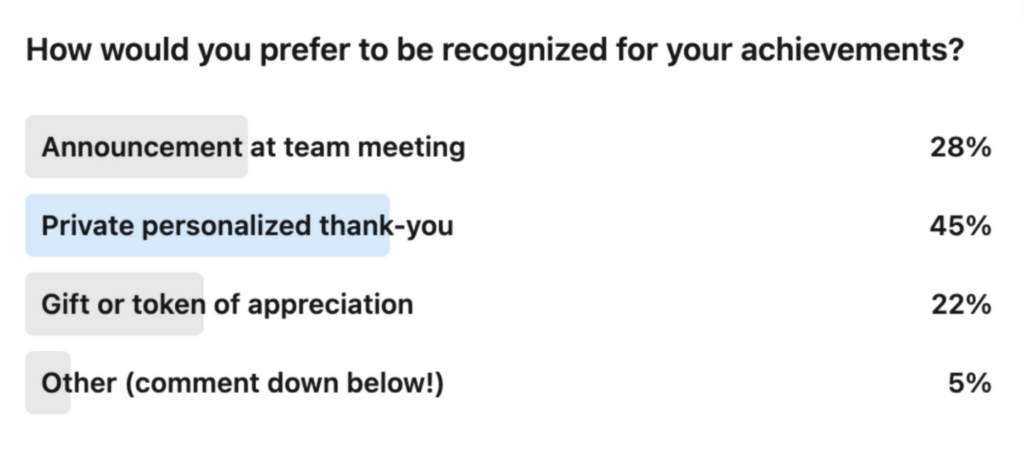
  • The Optimism Company recently conducted a poll with 13,790 participants, revealing that most workers prefer to be praised in private rather than in public.
  • Simon reveals his go-to method for giving effective praise.

Fact: We all love praise. Be it a little compliment on an outfit, a thank-you for some help with a task, or even just a thumbs-up after a presentation, praise is a ray of sunshine that can clear up a cloudy day. And yet we often forget that giving praise effectively is actually a skill. 

It’s not just about saying “good job” and moving on; it’s about making your team members feel valued and appreciated in a meaningful way. Also, how you choose to deliver your praise—whether it’s in public, in private, in person, over Slack—can make all the difference. 

For perspective, we recently conducted a poll to learn more about how people prefer to be acknowledged for their good work, and 13,790 people participated. The results were fascinating:

Turns out, most of the respondents indicated a preference for private conversations. This suggests that personalized, one-on-one praise goes a long way for many workers.

Others, however, felt differently. Some enjoy being acknowledged in front of their peers. Others value tangible rewards or gestures of appreciation, such as a handwritten note or a small gift.

Equally as interesting were the variety of detailed responses we received in the comments to our poll. People shared their unique and creative ideas for how they like to be praised. Here are just some of the comments from our poll participants (ed note: some have been lightly edited for clarity):

From Tonya B.:

I personally don’t need public accolades. However, I have learned that when it comes to work, praising in public can open doors. People are impressed by this sort of thing, so it can lead to new opportunities. So tell the world. Otherwise, an email for my ‘kudos’ folder and a cash bonus would be great!

From Sarah M.:

I love when my manager takes the time to give me specific feedback on my work. It shows that they’ve really paid attention and appreciate my efforts.

From Emily S.: 

“I appreciate when praise is tied to the bigger picture. Knowing how my contributions contribute to the team’s success motivates me to keep up the good work.”

From Cole T.:

“If promotion, raise, or bonus are not an option, then my preferred recognition would be a personal meeting with my leadership team where I was thanked for the stellar work and given the opportunity to share my key learnings from the experience. I could also  provide feedback on where I encountered hurdles and inefficiencies. This would really make me feel truly appreciated as it demonstrates to me that they actually care about the work I put in along with any ways the process can improve for next time.”

From Chuck D.:

“It’s not about how. It’s about intentions. Authenticity is powerful and memorable.”

As you see, giving praise effectively isn’t necessarily one-size-fits-all. 

Simon’s Tips for Giving Effective Praise

When choosing the setting for your praise—whether in a team meeting, a company town hall, or one-on-one—use your best judgment based on your knowledge of the employee and their preferences. When in doubt, Simon advises making it a one-on-one conversation.

“In-person is always the best,” he says. “Over-the-phone is second best. Giving praise over email and text are weak substitutes. As a general rule, if you can email someone, you can call them.”

For the praise itself, Simon suggests structuring it in a specific way:

  • Start with, “Here’s the thing you did.”
  • Then, say, “Here’s how I feel about what you did.”
  • Follow with, “Here’s the impact of what you did.”

He provides this example:

“Jennifer, when I was in your meeting the other day, I saw the way you talked to your team. It made me so proud and showed that you are the best example of our values. I am confident that if you keep doing that, your team and group will thrive beyond any of our expectations.”

Feels good, doesn’t it?

More Useful Advice from The Optimism Company

The Best Way to Give Feedback without Damaging Morale

Simon’s Red Flags for Knowing When to Quit Your Job

How to Master the Art of Working Less and Achieving More

Start Any Presentation with Confidence: Simon’s Expert Tips and Tricks

Curiosity is essential
                for progress.
SimonSignature

We fully agree, so we like to reward curiosity.
Use code GETCURIOUS for 20% off your next purchase.

A spark is something quite small and, by itself, not very powerful. But a spark has the ability to ignite. An idea is like a spark; alone it is just a set of words, but it too can ignite. A great idea can inspire others to dream bigger. Let us all work together to ignite something greater than ourselves.

Let us all be a Spark of Optimism.