Hands-On or Hands-Off: Which Leadership Style Is Better?

I’ve always sworn by my laissez-faire leadership style. I tend to leave people alone and let them do their thing. I’ve debated my style with others who are more prone to micro-managing. They make the argument that they have to be hands-on because when they are hands off things go wrong too often. 

Who’s right?

I used to give people a hard time if they worked on nights and weekends. I wanted to help them maintain work-life balance. But data that was given to me by Watercooler.ai, an AI company that looks for anomalies in the patterns of our workflow, showed me that I was actually doing more harm than good (which you can read here, if you are so inclined).

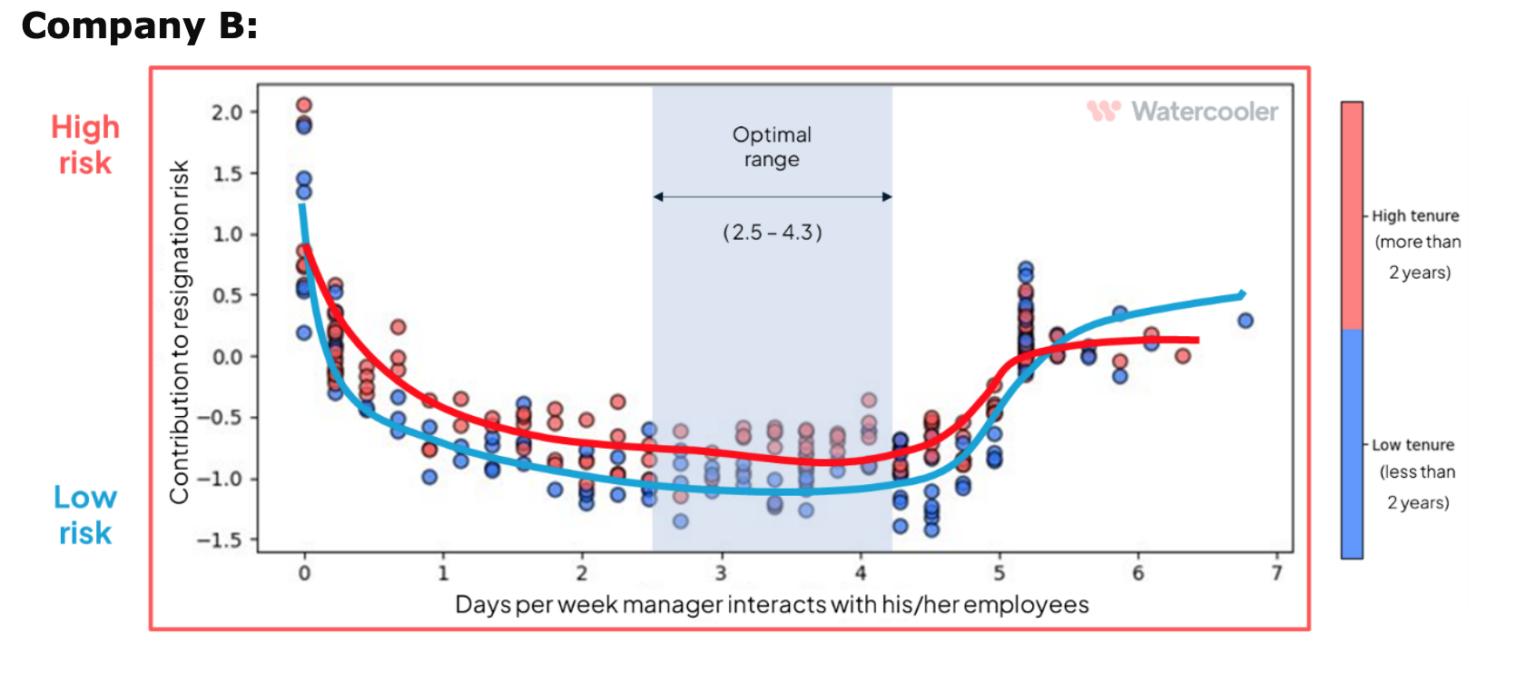
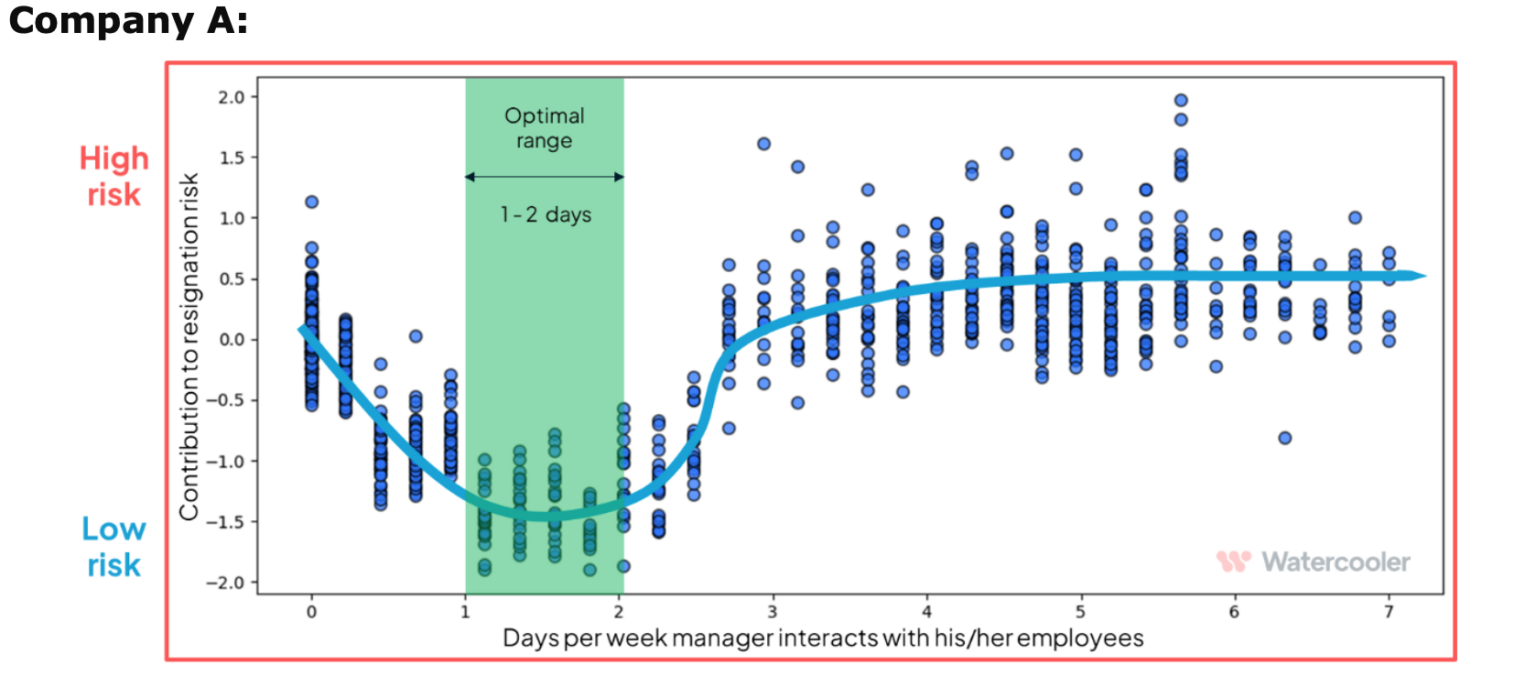
To better understand how much is the right amount to engage with our people, Watercooler showed me the data again. Unsurprisingly the right amount does vary by industry. But there is a sweet spot for each company. It turns out that engaging too little or too much can both contribute to increased chance of flight risk. 

Here are two examples:

For Company A, a sales-oriented organization, the optimal number of interactions is about 1 to 2 days during the week (including weekends). In Company B, an online training company, the frequency is interactions on 2.5 to 4.3 days during the week.

What’s important is that we need to strike a healthy balance between a hands-off and hands-on approach. Veering too far in either direction, the data shows, results in an increase of flight risk.

This kind of insight is particularly valuable when we move from one company, culture, or industry to another. What worked in our old job, may not work as well in our new job. AI can’t replace human leadership but can help show good leaders what they need to adjust to be the best leaders they can be for the culture in which they work. 

I’ve become so interested in the data that Watercooler analyzes that I became an advisor and investor in their company. The best part is that I get to have regular conversations with the CEO, Eitan Vesely, and his team and they show me what they are learning. Here’s a clip from a recent webinar we did together:

If you find this interesting and would like to hear more, here’s the link to the full webinar.

How Good Businesses Balance Employee Autonomy with Top-Down Control

Nothing can feel quite as soul crushing at work as when we take initiative to try something new and we’re shot down with words: “That’s not how we do things here.”

It’s simply a fact that, in any business, there’s a persistent tension between a centralized, top-down approach and the desire for team autonomy. This balancing act is crucial: how can we maintain alignment with the company’s goals while empowering employees to adapt, innovate, and take initiative on the front lines?

Striking this balance is essential for success. We need employees to buy into the larger corporate direction, but not at the cost of stifling individual creativity.

Will Guidara, bestselling author, renowned restaurateur, and former owner of the world’s #1 restaurant, Eleven Madison Park, describes this dilemma as the battle between “restaurant smarts” and “corporate smarts.” While his lessons are rooted in the restaurant industry, they are universally applicable to any business environment.

What Does “Restaurant Smart” Mean?

“Restaurant smart” companies lead with trust, granting frontline workers autonomy and creative freedom. These companies cultivate nimble environments where employees can serve customers with ingenuity.

“Think about Zappos, the online shoe retailer,” says Will. “In their call center, the customer service agents are given the freedom to go above and beyond for their customers. On one occasion, when one of the phone representatives learned of a customer’s sick mother, they took it upon themselves to send flowers to the mother’s hospital room. Most companies would think that was a waste of time and money. Zappos looked at it as an investment.”

However, while this approach fosters innovation and customer-centric service, it can also pose challenges. Companies that rely too heavily on flexibility and creativity may struggle with profitability due to a lack of standardized processes and controls. 

As Will says, “It’s very hard to scale a company if you’re only restaurant smart.” The very flexibility that drives innovation can also hinder consistency and efficiency—both critical for growth.

What About “Corporate Smarts?”

On the other hand, “corporate smart” companies prioritize systems, controls, and profitability, ensuring that every operation is streamlined and consistent. This approach, often driven by centralized decision-making, guarantees a uniform product and experience, regardless of location.

“McDonald’s is a corporate-smart company,” says Will. “Every time you walk into a McDonald’s, the product is exactly the same. You can expect consistency and efficiency, but it’s very rare that you leave a McDonald’s feeling anything but full.” 

The strength of corporate smarts lies in scalability and profitability, but it often comes at the expense of creativity and customer satisfaction. Frontline workers may feel disempowered, with little autonomy to make decisions that could elevate the customer experience.

Striking the Right Balance

The key to success lies in merging the best aspects of both approaches. By fostering creativity within a framework of efficiency and control, businesses can enhance customer satisfaction while achieving sustainable growth and profitability. This balance also fosters a sense of passion and purpose among employees.

“The challenge is to figure out how your company can be both restaurant smart and corporate smart, how to embrace the tension between control and creativity, and find the balance between the two,” says Will.

One example is Pret a Manger, which empowers its frontline staff while maintaining corporate controls. Pret cashiers have the autonomy to give away free drinks or food to customers they feel deserve it, acknowledging that those on the front lines have the insight needed to make such decisions.

To achieve this balance in your business, consider the following steps:

  • Empower Your Frontline Workers: Give employees the autonomy to make decisions that enhance the customer experience. Start small and build from there.
  • Establish Clear Systems: While empowering your team, ensure that systems are in place to maintain efficiency and control. This could involve setting guidelines for decision-making or implementing feedback loops to monitor the impact of creative initiatives.
  • Foster a Culture of Trust: Encourage open communication and trust within your organization. Make sure that creative ideas are welcomed and that employees feel supported in their roles.

As Will reminds us, “Even the smallest change can have a very significant result.” Start small, but start today—your business’s future depends on it.

For more, check out Will and Simon’s course, The Art of Creating Fiercely Loyal Customers.

One Overlooked Way to Be a Better Leader, According to a Neurologist

Leadership requires more than just skill, vision, and stellar communication. In the continuous quest to become better leaders, there’s one fundamental piece of advice that often gets overlooked: to be the best leader we can be, we must get a good night’s sleep.

Wait… Really? Sleep?

Sleep more impactful than you might expect. During sleep, critical brain activities occur that are vital for problem-solving and memory consolidation. In his Optimism Library class “Sleep Better, Feel Better, Achieve More,” Optimist Instructor Dr. Chris Winter explains: “Sleep is not just a period of rest, but a state where the consolidation of learning and memory enhancement happens.” This rejuvenation is crucial for leaders who need to make sharp, well-informed decisions daily.

Despite its importance, sleep is often the first sacrifice at the altar of leadership duties. The stats paint a stark picture: according to the CDC, 1 in 3 adults don’t get enough sleep, a statistic that is undoubtedly higher among leaders. This deprivation can lead to decreased alertness, impaired judgment, and poorer interpersonal interactions—none of which are marks of a good leader.

So, what can you do to improve your sleep? Here are some actionable steps:

  1. Consistent Sleep Schedule: Stick to a sleep schedule. Going to bed and waking up at the same time each day sets your body’s internal clock to expect rest.
  2. Create a Restful Environment: Make sure your bedroom is conducive to sleep. This means cool, dark, and quiet. As Dr. Winter suggests, “Your bedroom should be a sanctuary for sleep” .
  3. Wind Down Properly: Develop a pre-sleep routine that helps signal to your body that it’s time to wind down. This might include reading, stretching, or meditating.
  4. Limit Screen Time: The blue light emitted by screens can interfere with your ability to fall asleep. Try to cut off electronic devices at least an hour before bedtime.

Prioritizing sleep is not just about avoiding tiredness; it’s about enhancing your leadership capabilities. As research shows, leaders who get adequate sleep are more likely to display higher cognitive functions, better judgment, and enhanced empathy—all critical leadership qualities.

Remember, sleep is not a luxury—it is a necessity. By investing in rest, you’re investing in your ability to lead effectively and compassionately.

For more, check out The Optimism Library

4 Ways to Be a Better Remote Communicator

Let’s face it: mastering effective communication on platforms like Zoom is crucial, but it’s not something they teach in school. 

Whether you’re back in the office, working remotely, or somewhere in between, video conferencing is here to stay. A report from B2B Reviews shows that about 12.3% of the American workforce is fully remote, 65% wish they could work remotely all the time, and 32% prefer a hybrid setup. 

Elisabeth Cardiello, a communications expert and Optimist Instructor of “Build a Human Culture in the Zoom Era,” offers fantastic strategies for making the most of video conferencing to enhance workplace culture and communication. Here are four pivotal ways you can become a better communicator, backed by neuroscience and practical advice from Elisabeth’s expertise.

1. Embrace the “Brady Bunch” Layout

One of the unexpected gifts of video conferencing? The grid view, where you can see everyone’s faces simultaneously. Unlike in traditional boardroom settings, this layout allows you to gauge reactions and emotions in real time, fostering a deeper connection. Elisabeth says, “This is a gift because our social engagement system, the face-to-brain connection, is one of the fastest connections in our entire being. By observing and responding to these cues, you can enhance empathy and understanding in your communications.”

2. Minimize the Side Conversations

We’ve all been in a meeting and felt the urge to lean over to a coworker and chat. But sidebars can hinder productivity and lead to feelings of exclusion. “When there are side conversations at the end of the table,” Elisabeth says, “you’re back in fifth grade thinking, ‘Are they talking about me?’ Our brain knows that rejection is a big deal.” Video calls naturally reduce the possibility of side conversations, helping create a more engaged environment.

3. Cameras On

According to psychologist Albert Mehrabian, 55% of communication is conveyed through nonverbal cues like facial expressions and body language. This means cameras should be on. Set expectations for Zoom calls, especially in leadership positions, and include video call etiquette in your employee manual. Leading by example with cameras on encourages others to follow suit. Elisabeth stresses, “If we can see faces, we have a superpower.” 

Engaging visually—smiling, nodding, showing attentiveness—enhances communication clarity and effectiveness.

4. Get “Eye-lingual”

The way you look at someone significantly affects their comfort and openness during interactions. For instance, squinting your eyes with knitted brows might come off as judgmental rather than attentive. 

“If the person you are listening to perceives your eyes as open and supporting,” Elisabeth says, “they also perceive you as open to their thoughts and feelings.” This approach fosters a safe and open atmosphere, encouraging more honest and creative exchanges.

Remember: Each interaction is an opportunity to foster inclusion, empathy, and effectiveness, paving the way for a healthier and more productive workplace.

For more, check out The Optimism Library.


3 Things Employers Get Wrong About Gen Z, According to a Psychologist

Move over Boomers, cuz Gen Z is taking over at the office. 

Well, in numbers at least. That’s according to a study from Glassdoor, which predicts that Gen Z is expected to overtake baby boomers in the workforce by the end of 2024. 

For those who aren’t aware, Gen Z consists of individuals born roughly between 1997 and 2012. This generation is the first true group of digital natives, having been raised in the era of smartphones and social media, which significantly influences their communication habits, workplace expectations, and professional behavior.

As such, they are a gifted generation of new workers with a lot of creative ideas. They are passionate about what they believe in, are eager to take action to better their future, and they foster healthy doses of both realism and idealism… So why is it that they seem to be the communal punching bag for all the generations before them?

With some help from Dr. Mary Donohue and her class, “Managing an Intergenerational Team,” we’ve decided to take a closer look at Gen Z in the professional space, why they often get a bad rep, and how we can all work together in a more collaborative and supportive way.

Here are three common things we all say—and get wrong—about our most tech-savvy generation:

What People Say: “Gen Z is too technology-dependent and is always attached to their phones.”

We’ve all heard someone complain about how Gen Z cannot function without technology at their fingertips, usually grumbling about how “they are always glued to their devices.”

It’s easy to see why this assumption exists, as Gen Z has grown up with the internet and digital communication tools integral to their daily lives. However, labeling them as overly dependent on technology overlooks their ability to leverage these tools effectively for multitasking and efficient communication.

As Dr. Mary points out: “They’re visual, kinesthetic learners—they tend to use words that are grounded in the senses, words that really engage like ‘see, feel, look,’ This learning style makes them an asset in the office.” 

In other words, we should embrace their tech-savviness in the workplace by integrating modern communication tools that align with their proficiency. This not only plays to their strengths, it will also probably boost your offices operations and systems as a whole to be more efficient and less hands on.

What People Say: “Their communication skills are unprofessional.”

While it’s generally true that Gen Z prefers texting and social media, it does not mean that they lack the ability to engage in professional, formal communication.

As we’ve already established, they grew up in a technological age. With that age came the access to nearly instantaneous information, so it’s only natural that Gen Z favors concise and rapid communication forms. However, it doesn’t necessarily mean they’re incapable of formal interactions. 

They may not prefer traditional methods, but they can adapt when the context requires.

At the end of the day, it is up to the employers to set expectations. Dr. Donohue says, “On your onboarding, you’re going to want to ensure that you talk about what your rules are for answering the phone, what your rules are for voice.” 

Providing clear guidelines and training on professional communication standards helps bridge the gap. It’s about helping them understand when and how to use different communication styles effectively.

What People Say: “They never want to engage.”

In-person meetings and phone conversations—apparently, Gen Z hates them? 

This assumption often stems from their comfort with digital platforms. However, it’s not an aversion to personal interaction but rather a reflection of their environment and the communication evolution they’ve grown up with.

“This generation is hungry for learning,” says Dr. Mary, suggesting that Gen Z is open to developing new skills, including face-to-face communication. Incorporating more interactive and engaging methods such as video calls or in-person meetings can help them develop these essential skills. Encouraging a culture of open communication and mentorship can also provide them with opportunities to practice and improve their interpersonal interactions.

While we acknowledge that adapting and expectations is best when met both ways, it often feels as though it’s always the people in authority thinking the adjustments needing to be made are the sole undertaking of the younger generation. But think about the first job you ever started at. Did you know everything going in? Of course not, but with a little guidance and some time, you were able to adapt and eventually, find what it took to thrive in your position. So why shouldn’t your new Gen Z hires get that chance?

Understanding Gen Z’s unique characteristics and communication preferences is crucial in today’s diverse workplace. By debunking common assumptions and adapting workplace practices to meet their strengths, organizations can foster a more inclusive and productive environment.

For more, check out The Optimism Library

The Secret to Great Leadership, According to a Retired Army Colonel

The internet contains a sea of advice on leadership, and sometimes there’s so much information that it’s hard to cut through the noise. Colonel Chris Rogers, a seasoned veteran with over three decades of military and corporate experience, tells us that this sea of information is actually one of the greatest assets a leader can use. In his class in The Optimism Library, “The Five Disciplines of Leadership Development,” Chris explains that one of the ways a great leader distinguishes themselves from the rest is if they constantly take the time to educate themselves. 

According to Chris, continuous learning isn’t just an activity, but a leadership mindset. “Your diversity of experience informs your utility as a leader,” he says, suggesting that a broad spectrum of knowledge enhances decision-making and problem-solving abilities. 

After all, we are living in an era of rapid technological advancements and constantly shifting market dynamics. The key to great leadership is the ability to constantly adapt, to maintain relevance and effectiveness, and to guide teams through complex challenges and opportunities. Here’s how we all can implement continuous learning into our routines:

1. Diversify Our Sources and Always Be Listening:

Engage with a wide array of learning materials, from books and articles to podcasts and webinars. This exposure to various perspectives enriches your understanding and enhances your leadership toolkit.

Here’s an exercise to try: The next time you hear a piece of information that you initially disagree with, we challenge you to listen to the full argument. We know it can be frustrating, but exercise patience and try to listen neutrally. Not only will you be practicing active listening, you will also gain a better understanding of those who may have a different point of view, making it much easier to find common ground.

2. Set Learning Goals:

Like any other business objective, learning should have clear targets. Whether it’s mastering a new technology or understanding market trends, setting goals keeps you focused.

Start small with a chapter of a book per week. Listen to the relevant podcasts. Take a live online class that interests you. Or maybe a mix of different media forms is what keeps you engaged and excited to learn. 

To set incremental goals, start by identifying your long-term objective and breaking it down into smaller, manageable milestones. Use the SMART criteria (Specific, Measurable, Achievable, Relevant, Time-bound) to ensure each goal is clear and actionable. Employ the WOOP method (Wish, Outcome, Obstacle, Plan) to visualize success, identify potential obstacles, and create a concrete plan to overcome them. Prioritize your goals based on urgency and importance, and develop a detailed action plan outlining the necessary tasks, timeline, resources, and metrics for each incremental goal. Utilize tools such as project management software and habit-tracking apps to organize and track your progress.

Regularly monitor your progress and adjust your plans as needed, seeking feedback and accountability from mentors or peers to stay on track. Celebrate milestones to boost motivation and reinforce positive behavior. 

For example, if your long-term goal is to become a recognized expert in digital marketing within five years, an incremental goal could be obtaining a certification within the first year. This goal would involve specific tasks like enrolling in a course, dedicating study hours weekly, and passing the certification exam, all within a set timeframe. This structured approach ensures continuous improvement and steady progress toward your overarching goal.

3. Reflect and Apply:

Learning without reflection and application is fruitless. Rogers stresses the importance of reflection as a means to cement learning, “We create habits, good habits, through disciplined action.”

Embracing continuous learning is not merely an addition to a leader’s role but a fundamental aspect that distinguishes good leaders from great ones. A study by the Pew Research Center even found that 47% of those who engage in continuous learning say their extra training helped them advance within their current company. 

As Chris succinctly puts it, “Leadership development is not a destination, but rather it’s a journey.” Engaging actively with this journey through continuous learning ensures that leaders not only stay ahead of the curve but also pull their teams along with them towards sustained success and innovation.

For more, check out The Optimism Library

4 Ways to Make Better Decisions, According to a Psychologist

On average, adult human beings make 35,000 conscious decisions every day, each influenced by our perceptions and biases. Navigating this vast sea of choices, where the distinction between wisdom and folly often blurs, calls for expert guidance. Enter Dr. Justyna Kucharska, a renowned psychologist with deep expertise in neuroscience and psychology.

In her class “The Art of Decision Making” (which you can access in The Optimism Library), Dr. Kucharska takes us on a journey through the intricate workings of our minds, helping us understand the roots of our decision-making challenges. With her insights, we’re equipped to hone our ability to make smarter, more informed choices. What’s more, she exposes the hidden influences and subtle biases that can derail us, offering practical strategies to enhance our decision-making skills.

That’s right: Our brains often work against us. “Cognitive biases are simplifying strategies your brain uses,” explains Dr. Kucharska. “We all know that life is complicated, and information that we receive from the world is complex. And oftentimes, It’s really difficult to deal with it. So we need simplifying strategies that would allow us to deal with the complexity of information in life. That’s where these biases come into play.”

Recognizing our mental shortcuts is the first step toward making wiser choices. Let’s dive into four common cognitive biases that often lead us astray and explore practical advice on how to counteract them:

1. Confirmation Bias

We’ve all felt the wave of satisfaction when we get to say “I told you so!” But as it turns out, we crave that satisfaction because of a little thing called confirmation bias, which skews our reality. Confirmation bias prompts us to favor information that aligns with our existing beliefs, leading us to discount evidence that contradicts them.

For instance, if we believe that we’re always ineffective in our presentations, our brains will focus on the disengaged audience members the next time we present, confirming our belief that “we always mess up our presentations; no one was engaged.”

Here’s How to Beat It:

To counteract this bias, Dr. Kucharska suggests we call it out. By stepping back from our feelings and labeling our thoughts as biased, we can reopen our minds to other perspectives. “Confirmation bias means you’re likely to remember the disengaged faces while ignoring the interested ones,” she says. “Actively seek feedback to challenge your initial perceptions.”

This practice helps broaden our view, making our decision-making process more balanced and less subjective.

2. Sunk Cost Fallacy

The sunk cost fallacy occurs when we continue down a path that’s clearly not yielding results, simply because we’ve already invested heavily in it. For example, if we’ve ever thought, “I’ve already spent four years in this job I dislike, might as well stick it out,” we’ve fallen victim to the sunk cost fallacy.

Here’s How to Beat It:

The way out of the sunk cost fallacy is similar to the way out of confirmation bias: recognition. “Recognizing a bad investment is crucial—don’t let past investments dictate your future decisions,” says Dr. Kucharska. This can be aided by making pros and cons lists, talking through our concerns with supportive friends, or seeking advice from trusted coworkers.

Think of our happiness as the ultimate investment. If four years in a job isn’t fulfilling, it’s time to explore new opportunities that align with our career goals and invest in our quality of life. Accepting the costs that have been sunk can be hard, but deciding not to sink any further makes it easier.

3. Framing Bias

Even though we’ve all been told not to judge a book by its cover, our eyes can’t help but be drawn to the flashier sleeves. It’s all about presentation, and the same rule applies to our choices. This is the framing bias.

Our decisions are influenced by the way information is presented, rather than just the information itself. This bias can make us view the same situation in dramatically different ways, depending on how it’s framed.

For example, if we’re passed over for a promotion, we might immediately think, “I didn’t get the promotion; the system is rigged!” This reaction is influenced by framing bias.

Here’s How to Beat It:

Every time we feel ourselves slipping into framing bias, we should force ourselves to frame our thoughts in a few different ways. As much as it pains us to admit it sometimes, our truth is not always the truth. This is why, according to Dr. Kucharska, “We must always consider alternative interpretations.”

By reframing our perspective, we can see opportunities for growth instead of barriers. So, if we find ourselves thinking, “I didn’t get the promotion; the system is rigged,” we should follow it up with, “I didn’t get the promotion, but let’s analyze how I can improve my skills or alter my approach for the next opportunity.” This approach helps us make informed decisions about our next steps.

4. Overconfidence Bias

Nothing is quite as humbling as when we don’t prepare for something because we think we “totally have it in the bag” only to quickly find out that we very much did not. That’s the overconfidence bias in full effect.

Overconfidence bias occurs when we overestimate our knowledge, skill, or prediction accuracy. While it’s good to be confident, overconfidence can lead to unanticipated challenges.

Here’s How to Beat It:

“Adequate preparation combines confidence with humility,” says Dr. Kucharska. Next time we face a choice and the answer seems obvious, we should take a second to ask ourselves, “Is this confidence or is this arrogance?”

Acknowledging what we know while preparing thoroughly to cover what we don’t ensures we’re ready to handle unexpected questions and situations.

Becoming aware of these biases and actively counteracting them can transform the art of decision-making from an abstract trial-and-error process into a thoughtful, informed one. Together, we can refine our decision-making skills and navigate our choices more wisely. 

For more, check out The Optimism Library.

How to Leverage Your “Weaknesses” and Impress Hiring Managers

When it comes to crafting our résumés, here’s a refreshing truth to keep in mind: perfection is overrated. In fact, résumés can even be too perfect.

Perfect CVs may come across as disingenuous to hiring managers. A recent article in Forbes stated that 67% of hiring managers are able to immediately notice when a résumé is enhanced with AI. While AI is here to stay, of course, it’s important for us all to remember that companies still hire human beings—and being human comes with having human flaws. 

Understanding how to transform our perceived flaws into compelling strengths can be the key to landing a role that is not only satisfying but also empowering. David Rendell, author and Optimist Instructor, delves into this very concept in Embrace Your Imperfections, a class found in The Optimism Library, which is designed to inspire us to reassess our personal and professional narratives.

So, how do we present ourselves honestly and confidently enough to land the job? 

Here are some pointers: 

Identify and Reframe Our “Flaws”

The first step is to identify our perceived weaknesses. Make two columns and write them all down in the first column. Then, use the other column to take each perceived weakness and reframe them not as flaws but as strengths in the right context. 

“Many highly talented, brilliant, creative people think they’re not,” David says, “because the very traits that make them unique are often undervalued or stigmatized.” 

For example, if we’re often criticized for being overly detailed, we can reframe this trait as thoroughness—a critical skill in fields requiring meticulous attention, such as accounting or software development.

Tailor the Narrative

When preparing for interviews, we should tailor our narrative to highlight how these traits have been instrumental in achieving success. See these weaknesses as what they actually are: continuous lessons in self-improvement.

David says: “To recognize those characteristics, those negative characteristics, those seeming disadvantages, those weaknesses, and to transform them into strengths—it shows ourselves and others our capacity to grow and our gratitude to what we have learned.”

Provide Specific Examples

We should offer concrete examples of how what might be perceived as a weakness has helped us excel in past roles. 

So, let’s say we get asked about potential weaknesses in a job interview and decide to discuss “impatience.” We could say, “One trait that can be seen as a weakness is my impatience. However, this trait also drives me to be highly proactive and results-oriented. For example, in my last role, my urgency to push projects forward helped us meet all our project deadlines ahead of schedule. My ability to maintain momentum on projects ensures that we don’t just meet targets but exceed them by continually pushing the team towards efficiency.”

This example demonstrates how we’ve taken a characteristic that could be seen negatively and shown its positive impact in a professional setting, aligning with David’s philosophy that every negative trait has a positive side.

Adjust Our Mindset

Go about life with the mindset that every trait has a dual nature, especially when we go into interviews. If questioned about a weakness, be honest, but remain confident. Pivot the conversation to demonstrate how this characteristic is beneficial, providing those examples that we mentioned in the previous step. 

“Those negative characteristics are also positive characteristics,” David says.

It may take some time to get used to this mindset, but once we get used to it, we will feel more balanced, capable, and confident.

Seek the Right Fit

Finally, focus on roles and companies that value our unique skills. “Alignment between personal traits and job requirements is key,” David says. “Find alignment in personal and professional environments that capitalize on natural strengths and you’ll have found somewhere you can operate within at your natural best.”

For more, check out The Optimism Library.
FRIENDLY REMINDER! For a Limited Time, You Can Get Simon’s “The Art of Presenting” and Unlock 50+ Free Career-Building Classes (a $60 Value!). For more, see here

One Really Simple Way You Can Be a Better Friend, According to Simon

Simon Sinek, our founder and Chief Optimist, has spent a lot of time collaborating with various branches of the military. He will be the first person to tell you that through these experiences he has learned some really profound lessons about friendship—one of which he wanted to share:

“Of the many things I’ve learned from those experiences,” says Simon, “first and foremost is that I am a better friend because of my military friends. They’ve taught me about the power of vulnerability and sincerity when talking to the people I love.”

Years ago, he was talking to a particular military friend. “We were catching up, talking each other through our respective problems, and just being there for one another,” he says.“Finally, we were finishing up our phone call, and before they hung up, they said I love you, brother.

Simon was initially taken aback. He says, “the first time my friend said that to me, I almost couldn’t believe it. After all, these are some of the most hardened warriors who have seen such horrible things.”

But it wasn’t a mistake, and it wasn’t flippant or thrown out there casually; they didn’t just say, Love you! They said, I love you, brother. 

“The word ‘I’ was in there,” he says. “It was sincere. I’ll never forget the way it made me feel.”

In civilian life, we have colleagues and co-workers, but in the military, they have brothers and sisters. Using such a familial term establishes deeply and honestly that there’s love there.

Simon took it to heart. “Now, I say “I love you” to my friends and call them brother or sister,” he says. “It’s amazing to see how they respond to that. Even friends of mine who are emotionally distant. When I started saying “I love you” to them on the phone, they started saying it back.”

So, we encourage you to say I love you to your friends. Call them brother and sister—

“—but only if you truly mean it,” says Simon. “Don’t use those terms lightly.”

Curiosity is essential
                for progress.
SimonSignature

We fully agree, so we like to reward curiosity.
Use code GETCURIOUS for 20% off your next purchase.

A spark is something quite small and, by itself, not very powerful. But a spark has the ability to ignite. An idea is like a spark; alone it is just a set of words, but it too can ignite. A great idea can inspire others to dream bigger. Let us all work together to ignite something greater than ourselves.

Let us all be a Spark of Optimism.