How I’m Learning to Embrace Loneliness

My whole life I have managed loneliness. It’s not the kind of severe loneliness or social isolation equated with depression. Mine is a kind of loneliness that goes with being physically alone, either living alone or being single. And for most of my life, I have been one or both of those things. My loneliness feels more like a gentle sadness of longing or being without. 

For years, when the feeling of loneliness would show up, I would yearn for the thing that made that feeling go away. If I was single, I yearned for a partner. If I was home alone, I yearned for the company of another. 

I recently had a conversation with my friend Ric, who is like a guru to those who know him. I asked him if he ever feels lonely. 

“I am never alone,” he replied, “I am always with myself.”

Ric’s perspective on loneliness set me on a new path. Instead of yearning for the thing that will make my loneliness go away, I am, instead, learning to understand what it is and how it fits in—even belongs in my life. 

Here’s what I’ve learned. 

My loneliness is not a bad thing that I have to get rid of. It is now a healthy part of a balanced life for me. One of the things that comes with being alone is total freedom. I’m not just talking about the freedom to go places, though that exists too. I am talking about a more mundane kind of freedom. I can watch anything I want on TV, for example. I can eat anything for dinner, even gross combinations of food on one plate. It’s a freedom to make any decision I want, any time I want. But this incredible freedom has a price, and that price is the feeling of occasional loneliness. And because I so appreciate my freedom, this seems a small price to pay. 

The opposite is also true. I love being in relationships and with friends. I love the feeling of companionship and togetherness. But when I have that, it also has a cost. And that cost is loss of freedom. When we are with others, we have to consider their needs and wants. Sometimes at the sacrifice of our own. That’s the price of companionship.

The best relationships, the best friendships, and indeed the best personal lives are able to find the right balance between freedom and companionship. It’s sometimes an imperfect dance, but it is not about eliminating feelings of sadness or yearning; it is about weighing costs and benefits. 

Being alone or being with someone is no longer a comparison I make. One is no longer more desirable than the other. They are simply different states of being that come with their own costs. And sometimes the cost for the thing we get is worth it. 

One Mistake Too Many Leaders Make in Meetings

We’ve all been there—we’re in a meeting and the person leading the call asks a question. The conversation pauses, and suddenly, time seems to drag on at half the speed. The silence is deafening… and awkward. It’s a common scene in work environments, but it’s how leaders decide to react that defines how they will shape team morale and the psychological safety of its members.

When a meeting falls into silence—or feels stuck and unproductive—it’s a natural reaction for leaders to feel frustrated and want to call on participants randomly to engage. Elisabeth Cardiello, a seasoned communications expert and Optimist Instructor, would advise leaders to avoid this. 

Now, let’s first clarify what “calling on” means. We know every leader managing a meeting has to speak to people, ask questions, ask for updates, and generally expect a base level of participation. Those sorts of interactions would not constitute as being “called on,” given that those interactions are expected and often prepped for. Being “called on” is when a leader asks a question in a meeting, is then met with silence, and then decides to put someone on the spot and volunteer them to answer, even though they were not wanting to do so.

“Calling on people? People’s hands aren’t raised in an office,” says Elisabeth. “If you start calling on people, you’re bringing them right back to grade school, when someone was like, ‘What’s the answer to the math problem?‘ When you’re called on randomly, the natural reaction is, ‘Oh, my God, I have no clue and this is terrible.’” 

This approach can make team members feel put on the spot, increasing anxiety, and diminishing their sense of safety and comfort within the group. In the quest for engaging your team you are actively diminishing trust.

Here’s What Leaders Should Do Instead

So, how do you beat awkward silences in meetings? Well, here’s the thing… you don’t.

Instead of reverting to classroom tactics, Elisabeth recommends embracing these silences as productive and thoughtful pauses. Silence doesn’t necessarily indicate disengagement; often, it means participants are processing information, formulating thoughts, or considering their responses. Make it known to your team that you’re OK with silence and are willing to give as much time as needed for them to reflect— hopefully then the tension will dissipate and good ideas will start to come forward.

For virtual meetings, she suggests the “popcorn style” method to avoid these awkward moments. The “popcorn” method encourages voluntary participation.

“Whoever wants to share first, they unmute, they share. When they’re done, they re-mute,” she says. “The next person that wants to go unmutes and they share when they’re done, they re-mute, and so on.” If your meetings are in-person, you can still adhere to this style, simply speaking up when you want to contribute and then leaving the floor open for others to share their thoughts, as well. 

This style respects the natural flow of conversation and doesn’t pressure anyone to speak before they are ready. It fosters a more relaxed environment where people can contribute thoughtfully and at their own pace. “Silence just means that we’re being thoughtful, right? Silence is a good thing. It means we’re actually thinking there’s something happening,” says Elisabeth. 

So next time you’re leading a meeting and encounter a stretch of silence, remember it’s an opportunity for reflection, not a gap that needs filling. Encourage a culture where everyone feels they can contribute when they’re ready, not because they’re compelled to. A simple acknowledgment, such as saying “Thank you for sharing,” can go a long way in building trust and encouraging open, stress-free communication within your team.

For more, check out The Optimism Library.

Why We Need Each Other

I try, try, try and fail. Only then will I learn and improve the way to do things.

I go, go, go and trip. I stand up, brush off my knees, look back at what I tripped over so I know what to look out for in the future. Now I don’t have to trip over those things again.

I run faster and faster and faster, then miss my turn and have to go back and try again. But now I know what signs to look for to keep me moving in the right direction.

I go alone, alone, alone until I find someone on the same path and we decide to run together. I share all my falls, trips and missed turns so they can benefit from my effort. They tell me about all their falls, trips and missed opportunities so I can learn from their experiences.

Then together, we can run faster, straighter and more confidently to the place we want to go.

5 Freelance Strategies to Boost Your Earnings and Impact

Imagine this: you’ve just landed a meeting with a potential client, and now comes the big moment—discussing your rates. You want to ask for what you’re worth, but a nagging voice inside makes you hesitate. What if they think you’re too expensive? What if they go with someone cheaper? This scenario is all too familiar for freelancers, but according to Alison Grade, author of The Freelance Bible and a seasoned expert in the freelancing world, it doesn’t have to be.

Alison has spent her career helping freelancers turn their skills into successful businesses, emphasizes the importance of viewing yourself and your freelancing work as a high-value offering. In her class “Be a Great Freelancer“, Alison explains, “freelancing isn’t just about trading time for money; it’s about the impact your work has on your client’s business”. Understanding this concept is the key to not only commanding higher fees but also attracting better clients and creating more sustainable business relationships.

So, why is it beneficial to see yourself as high value? Alison points out that clients hire freelancers for two main reasons: they either need specialist skills they can’t afford to keep in-house or they need extra capacity to handle an influx of work. In either case, you’re offering something they can’t easily replicate, and that’s worth a premium.

Here are a few actionable steps to help you, noble freelancer, articulate your unique value:

1. Conduct a Skills Audit

 Take stock of your hard skills (technical abilities), soft skills (like communication and leadership), and even those “other” skills you might not think to include, such as hobbies or languages. Alison explains, “The more you understand about what you bring to the table, the better you can articulate it to potential clients.”


2. Understand the Client’s Needs

According to Alison, you should always ask yourself these two questions whenever a new project is a possibility: “Why is this client hiring me? Is it for specialist skills or added capacity?” Understanding the reason behind a client’s need for your services can help you tailor your pitch. If you’re clear on whether you’re filling a skill gap or providing much-needed support, you can position yourself as the perfect solution to their problem.


3. Articulate the Impact, Not Just the Task 

Instead of focusing solely on the tasks you’ll perform, highlight the impact your work will have on the client’s business. “It’s not about what you do, but what your work enables,” says Alison. For instance, instead of saying you’ll manage their social media accounts, explain how your work will increase their brand visibility and drive customer engagement.


4. Use Clear, Confident Language 

When discussing your rates or pitching your services, use clear and confident language. Don’t use phrases like “I think” or “maybe,” as these can undermine your perceived value. Instead, be direct about what you offer and how it benefits the client.


5. Seek Feedback and Adjust

After completing a project, don’t hesitate to ask for feedback. Grade suggests, “Understanding how clients perceive your value can help you refine your pitch and improve future client interactions.” Positive feedback can reinforce your confidence, while constructive criticism can provide insights into areas where you can further articulate your value.


By following these steps, freelancers can shift their mindset from merely completing tasks to delivering high-impact results. This approach not only helps justify higher rates but also builds stronger, more trusting relationships with clients. After all, the most important tool a freelancer can have is confidence if the hard work they have accumulated over their career. 

You are a luxury, desirable item—price yourself accordingly.

For more, check out The Optimism Library.


Hands-On or Hands-Off: Which Leadership Style Is Better?

I’ve always sworn by my laissez-faire leadership style. I tend to leave people alone and let them do their thing. I’ve debated my style with others who are more prone to micro-managing. They make the argument that they have to be hands-on because when they are hands off things go wrong too often. 

Who’s right?

I used to give people a hard time if they worked on nights and weekends. I wanted to help them maintain work-life balance. But data that was given to me by Watercooler.ai, an AI company that looks for anomalies in the patterns of our workflow, showed me that I was actually doing more harm than good (which you can read here, if you are so inclined).

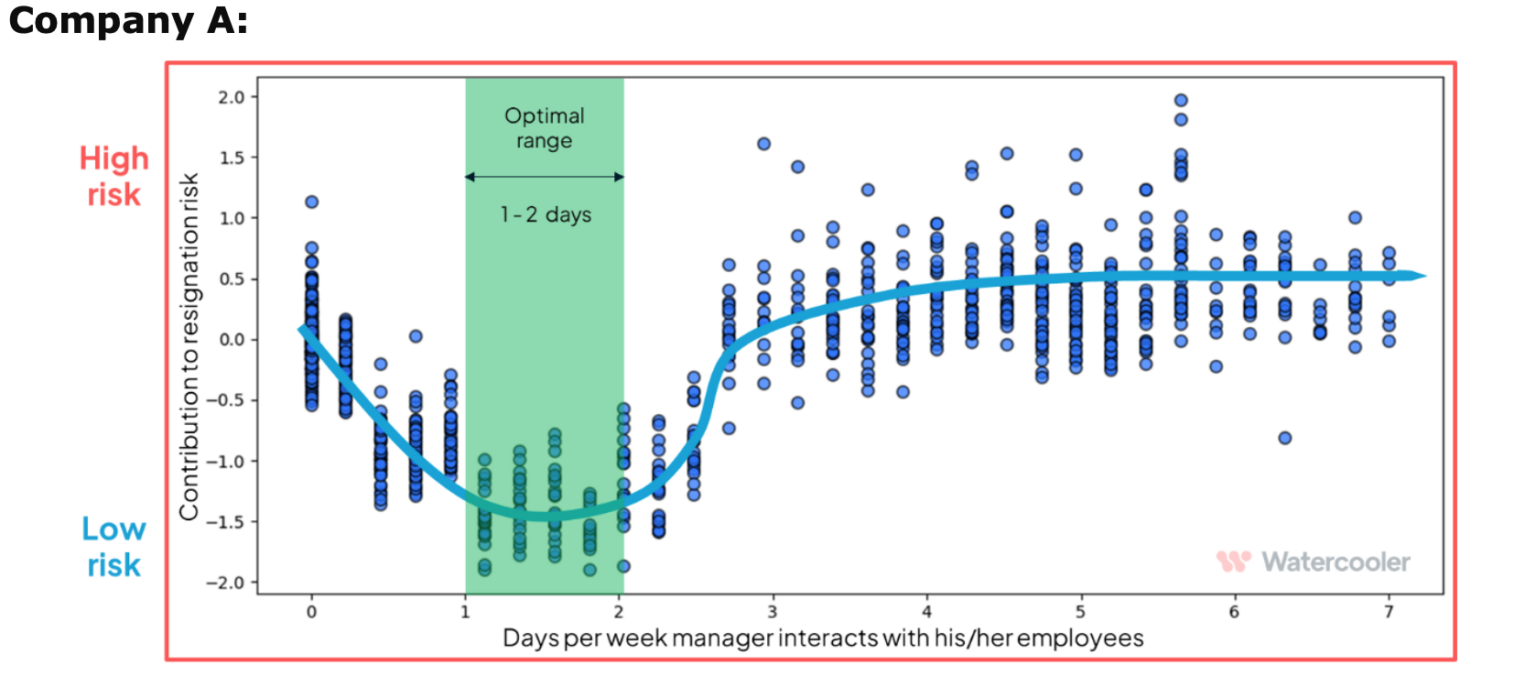
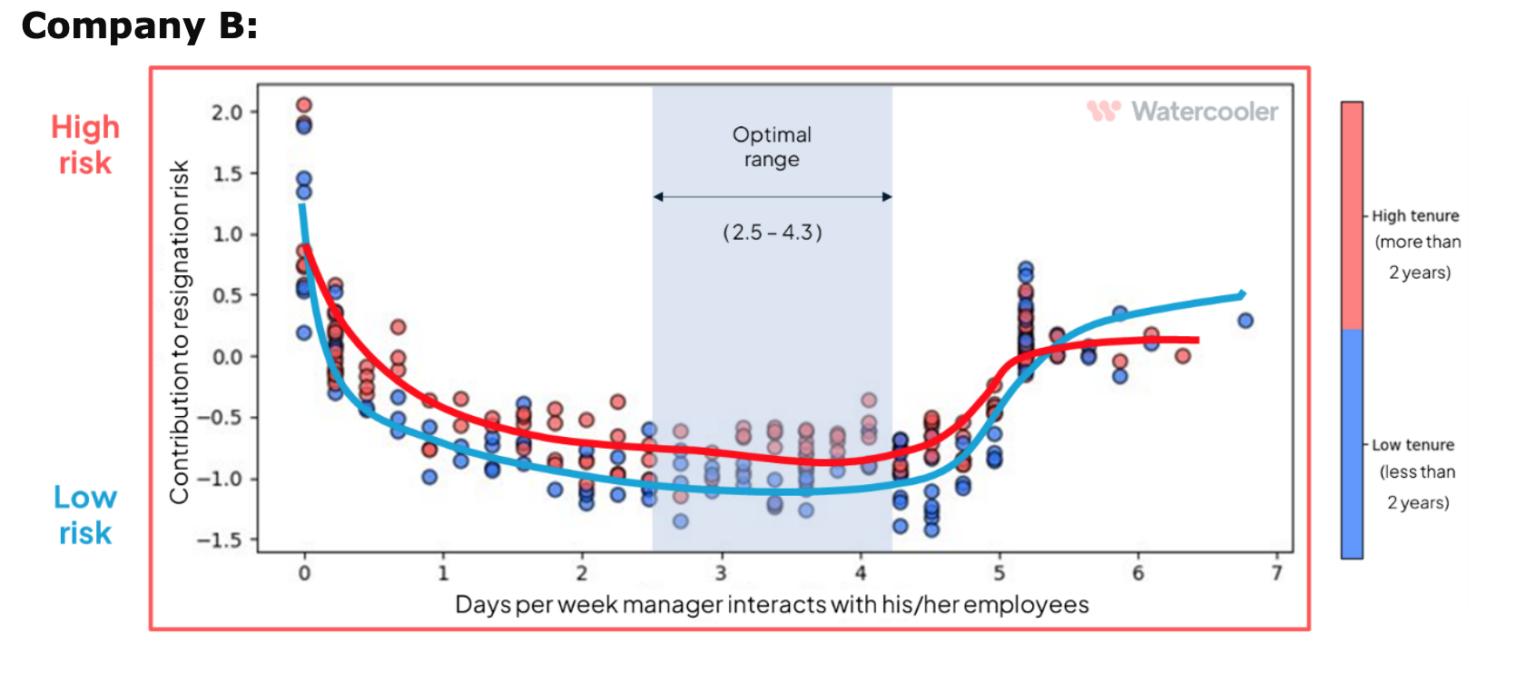
To better understand how much is the right amount to engage with our people, Watercooler showed me the data again. Unsurprisingly the right amount does vary by industry. But there is a sweet spot for each company. It turns out that engaging too little or too much can both contribute to increased chance of flight risk. 

Here are two examples:

For Company A, a sales-oriented organization, the optimal number of interactions is about 1 to 2 days during the week (including weekends). In Company B, an online training company, the frequency is interactions on 2.5 to 4.3 days during the week.

What’s important is that we need to strike a healthy balance between a hands-off and hands-on approach. Veering too far in either direction, the data shows, results in an increase of flight risk.

This kind of insight is particularly valuable when we move from one company, culture, or industry to another. What worked in our old job, may not work as well in our new job. AI can’t replace human leadership but can help show good leaders what they need to adjust to be the best leaders they can be for the culture in which they work. 

I’ve become so interested in the data that Watercooler analyzes that I became an advisor and investor in their company. The best part is that I get to have regular conversations with the CEO, Eitan Vesely, and his team and they show me what they are learning. Here’s a clip from a recent webinar we did together:

If you find this interesting and would like to hear more, here’s the link to the full webinar.

How Good Businesses Balance Employee Autonomy with Top-Down Control

Nothing can feel quite as soul crushing at work as when we take initiative to try something new and we’re shot down with words: “That’s not how we do things here.”

It’s simply a fact that, in any business, there’s a persistent tension between a centralized, top-down approach and the desire for team autonomy. This balancing act is crucial: how can we maintain alignment with the company’s goals while empowering employees to adapt, innovate, and take initiative on the front lines?

Striking this balance is essential for success. We need employees to buy into the larger corporate direction, but not at the cost of stifling individual creativity.

Will Guidara, bestselling author, renowned restaurateur, and former owner of the world’s #1 restaurant, Eleven Madison Park, describes this dilemma as the battle between “restaurant smarts” and “corporate smarts.” While his lessons are rooted in the restaurant industry, they are universally applicable to any business environment.

What Does “Restaurant Smart” Mean?

“Restaurant smart” companies lead with trust, granting frontline workers autonomy and creative freedom. These companies cultivate nimble environments where employees can serve customers with ingenuity.

“Think about Zappos, the online shoe retailer,” says Will. “In their call center, the customer service agents are given the freedom to go above and beyond for their customers. On one occasion, when one of the phone representatives learned of a customer’s sick mother, they took it upon themselves to send flowers to the mother’s hospital room. Most companies would think that was a waste of time and money. Zappos looked at it as an investment.”

However, while this approach fosters innovation and customer-centric service, it can also pose challenges. Companies that rely too heavily on flexibility and creativity may struggle with profitability due to a lack of standardized processes and controls. 

As Will says, “It’s very hard to scale a company if you’re only restaurant smart.” The very flexibility that drives innovation can also hinder consistency and efficiency—both critical for growth.

What About “Corporate Smarts?”

On the other hand, “corporate smart” companies prioritize systems, controls, and profitability, ensuring that every operation is streamlined and consistent. This approach, often driven by centralized decision-making, guarantees a uniform product and experience, regardless of location.

“McDonald’s is a corporate-smart company,” says Will. “Every time you walk into a McDonald’s, the product is exactly the same. You can expect consistency and efficiency, but it’s very rare that you leave a McDonald’s feeling anything but full.” 

The strength of corporate smarts lies in scalability and profitability, but it often comes at the expense of creativity and customer satisfaction. Frontline workers may feel disempowered, with little autonomy to make decisions that could elevate the customer experience.

Striking the Right Balance

The key to success lies in merging the best aspects of both approaches. By fostering creativity within a framework of efficiency and control, businesses can enhance customer satisfaction while achieving sustainable growth and profitability. This balance also fosters a sense of passion and purpose among employees.

“The challenge is to figure out how your company can be both restaurant smart and corporate smart, how to embrace the tension between control and creativity, and find the balance between the two,” says Will.

One example is Pret a Manger, which empowers its frontline staff while maintaining corporate controls. Pret cashiers have the autonomy to give away free drinks or food to customers they feel deserve it, acknowledging that those on the front lines have the insight needed to make such decisions.

To achieve this balance in your business, consider the following steps:

  • Empower Your Frontline Workers: Give employees the autonomy to make decisions that enhance the customer experience. Start small and build from there.
  • Establish Clear Systems: While empowering your team, ensure that systems are in place to maintain efficiency and control. This could involve setting guidelines for decision-making or implementing feedback loops to monitor the impact of creative initiatives.
  • Foster a Culture of Trust: Encourage open communication and trust within your organization. Make sure that creative ideas are welcomed and that employees feel supported in their roles.

As Will reminds us, “Even the smallest change can have a very significant result.” Start small, but start today—your business’s future depends on it.

For more, check out Will and Simon’s course, The Art of Creating Fiercely Loyal Customers.

One Overlooked Way to Be a Better Leader, According to a Neurologist

Leadership requires more than just skill, vision, and stellar communication. In the continuous quest to become better leaders, there’s one fundamental piece of advice that often gets overlooked: to be the best leader we can be, we must get a good night’s sleep.

Wait… Really? Sleep?

Sleep more impactful than you might expect. During sleep, critical brain activities occur that are vital for problem-solving and memory consolidation. In his Optimism Library class “Sleep Better, Feel Better, Achieve More,” Optimist Instructor Dr. Chris Winter explains: “Sleep is not just a period of rest, but a state where the consolidation of learning and memory enhancement happens.” This rejuvenation is crucial for leaders who need to make sharp, well-informed decisions daily.

Despite its importance, sleep is often the first sacrifice at the altar of leadership duties. The stats paint a stark picture: according to the CDC, 1 in 3 adults don’t get enough sleep, a statistic that is undoubtedly higher among leaders. This deprivation can lead to decreased alertness, impaired judgment, and poorer interpersonal interactions—none of which are marks of a good leader.

So, what can you do to improve your sleep? Here are some actionable steps:

  1. Consistent Sleep Schedule: Stick to a sleep schedule. Going to bed and waking up at the same time each day sets your body’s internal clock to expect rest.
  2. Create a Restful Environment: Make sure your bedroom is conducive to sleep. This means cool, dark, and quiet. As Dr. Winter suggests, “Your bedroom should be a sanctuary for sleep” .
  3. Wind Down Properly: Develop a pre-sleep routine that helps signal to your body that it’s time to wind down. This might include reading, stretching, or meditating.
  4. Limit Screen Time: The blue light emitted by screens can interfere with your ability to fall asleep. Try to cut off electronic devices at least an hour before bedtime.

Prioritizing sleep is not just about avoiding tiredness; it’s about enhancing your leadership capabilities. As research shows, leaders who get adequate sleep are more likely to display higher cognitive functions, better judgment, and enhanced empathy—all critical leadership qualities.

Remember, sleep is not a luxury—it is a necessity. By investing in rest, you’re investing in your ability to lead effectively and compassionately.

For more, check out The Optimism Library

4 Ways to Be a Better Remote Communicator

Let’s face it: mastering effective communication on platforms like Zoom is crucial, but it’s not something they teach in school. 

Whether you’re back in the office, working remotely, or somewhere in between, video conferencing is here to stay. A report from B2B Reviews shows that about 12.3% of the American workforce is fully remote, 65% wish they could work remotely all the time, and 32% prefer a hybrid setup. 

Elisabeth Cardiello, a communications expert and Optimist Instructor of “Build a Human Culture in the Zoom Era,” offers fantastic strategies for making the most of video conferencing to enhance workplace culture and communication. Here are four pivotal ways you can become a better communicator, backed by neuroscience and practical advice from Elisabeth’s expertise.

1. Embrace the “Brady Bunch” Layout

One of the unexpected gifts of video conferencing? The grid view, where you can see everyone’s faces simultaneously. Unlike in traditional boardroom settings, this layout allows you to gauge reactions and emotions in real time, fostering a deeper connection. Elisabeth says, “This is a gift because our social engagement system, the face-to-brain connection, is one of the fastest connections in our entire being. By observing and responding to these cues, you can enhance empathy and understanding in your communications.”

2. Minimize the Side Conversations

We’ve all been in a meeting and felt the urge to lean over to a coworker and chat. But sidebars can hinder productivity and lead to feelings of exclusion. “When there are side conversations at the end of the table,” Elisabeth says, “you’re back in fifth grade thinking, ‘Are they talking about me?’ Our brain knows that rejection is a big deal.” Video calls naturally reduce the possibility of side conversations, helping create a more engaged environment.

3. Cameras On

According to psychologist Albert Mehrabian, 55% of communication is conveyed through nonverbal cues like facial expressions and body language. This means cameras should be on. Set expectations for Zoom calls, especially in leadership positions, and include video call etiquette in your employee manual. Leading by example with cameras on encourages others to follow suit. Elisabeth stresses, “If we can see faces, we have a superpower.” 

Engaging visually—smiling, nodding, showing attentiveness—enhances communication clarity and effectiveness.

4. Get “Eye-lingual”

The way you look at someone significantly affects their comfort and openness during interactions. For instance, squinting your eyes with knitted brows might come off as judgmental rather than attentive. 

“If the person you are listening to perceives your eyes as open and supporting,” Elisabeth says, “they also perceive you as open to their thoughts and feelings.” This approach fosters a safe and open atmosphere, encouraging more honest and creative exchanges.

Remember: Each interaction is an opportunity to foster inclusion, empathy, and effectiveness, paving the way for a healthier and more productive workplace.

For more, check out The Optimism Library.


3 Things Employers Get Wrong About Gen Z, According to a Psychologist

Move over Boomers, cuz Gen Z is taking over at the office. 

Well, in numbers at least. That’s according to a study from Glassdoor, which predicts that Gen Z is expected to overtake baby boomers in the workforce by the end of 2024. 

For those who aren’t aware, Gen Z consists of individuals born roughly between 1997 and 2012. This generation is the first true group of digital natives, having been raised in the era of smartphones and social media, which significantly influences their communication habits, workplace expectations, and professional behavior.

As such, they are a gifted generation of new workers with a lot of creative ideas. They are passionate about what they believe in, are eager to take action to better their future, and they foster healthy doses of both realism and idealism… So why is it that they seem to be the communal punching bag for all the generations before them?

With some help from Dr. Mary Donohue and her class, “Managing an Intergenerational Team,” we’ve decided to take a closer look at Gen Z in the professional space, why they often get a bad rep, and how we can all work together in a more collaborative and supportive way.

Here are three common things we all say—and get wrong—about our most tech-savvy generation:

What People Say: “Gen Z is too technology-dependent and is always attached to their phones.”

We’ve all heard someone complain about how Gen Z cannot function without technology at their fingertips, usually grumbling about how “they are always glued to their devices.”

It’s easy to see why this assumption exists, as Gen Z has grown up with the internet and digital communication tools integral to their daily lives. However, labeling them as overly dependent on technology overlooks their ability to leverage these tools effectively for multitasking and efficient communication.

As Dr. Mary points out: “They’re visual, kinesthetic learners—they tend to use words that are grounded in the senses, words that really engage like ‘see, feel, look,’ This learning style makes them an asset in the office.” 

In other words, we should embrace their tech-savviness in the workplace by integrating modern communication tools that align with their proficiency. This not only plays to their strengths, it will also probably boost your offices operations and systems as a whole to be more efficient and less hands on.

What People Say: “Their communication skills are unprofessional.”

While it’s generally true that Gen Z prefers texting and social media, it does not mean that they lack the ability to engage in professional, formal communication.

As we’ve already established, they grew up in a technological age. With that age came the access to nearly instantaneous information, so it’s only natural that Gen Z favors concise and rapid communication forms. However, it doesn’t necessarily mean they’re incapable of formal interactions. 

They may not prefer traditional methods, but they can adapt when the context requires.

At the end of the day, it is up to the employers to set expectations. Dr. Donohue says, “On your onboarding, you’re going to want to ensure that you talk about what your rules are for answering the phone, what your rules are for voice.” 

Providing clear guidelines and training on professional communication standards helps bridge the gap. It’s about helping them understand when and how to use different communication styles effectively.

What People Say: “They never want to engage.”

In-person meetings and phone conversations—apparently, Gen Z hates them? 

This assumption often stems from their comfort with digital platforms. However, it’s not an aversion to personal interaction but rather a reflection of their environment and the communication evolution they’ve grown up with.

“This generation is hungry for learning,” says Dr. Mary, suggesting that Gen Z is open to developing new skills, including face-to-face communication. Incorporating more interactive and engaging methods such as video calls or in-person meetings can help them develop these essential skills. Encouraging a culture of open communication and mentorship can also provide them with opportunities to practice and improve their interpersonal interactions.

While we acknowledge that adapting and expectations is best when met both ways, it often feels as though it’s always the people in authority thinking the adjustments needing to be made are the sole undertaking of the younger generation. But think about the first job you ever started at. Did you know everything going in? Of course not, but with a little guidance and some time, you were able to adapt and eventually, find what it took to thrive in your position. So why shouldn’t your new Gen Z hires get that chance?

Understanding Gen Z’s unique characteristics and communication preferences is crucial in today’s diverse workplace. By debunking common assumptions and adapting workplace practices to meet their strengths, organizations can foster a more inclusive and productive environment.

For more, check out The Optimism Library

Curiosity is essential
                for progress.
SimonSignature

We fully agree, so we like to reward curiosity.
Use code GETCURIOUS for 20% off your next purchase.

A spark is something quite small and, by itself, not very powerful. But a spark has the ability to ignite. An idea is like a spark; alone it is just a set of words, but it too can ignite. A great idea can inspire others to dream bigger. Let us all work together to ignite something greater than ourselves.

Let us all be a Spark of Optimism.